Stranger, I’m not sure, to tell you the truth. I just went down a bit of a rabbit hole trying to understand something, and I’m kind of tired.
did you end up finding that which you sought?
Maybe a little, at least I grasped more than I had before. The topic may only be truly important to me alone, at least that is what I worry about sometimes. I get distracted from the task by certain … incidentals.
you mean, by what other’s reactions are, don’t you?
Yes.
perhaps you could see what you are doing more like putting a message in a bottle, csofand … it is an act of faith and hope that realistically expects no immediate response … though time may bring it eventually.
That is a good way to look at it Stranger. I have been pouring a great deal of time and effort into crafting my messages, making them pleasing to me aesthetically, and perhaps considering them overly precious. But really I am lucky if anyone reads them once. Even if that happens, they won’t come back to them again later on. People are busy, and there are an awful lot of bottles floating around out there.
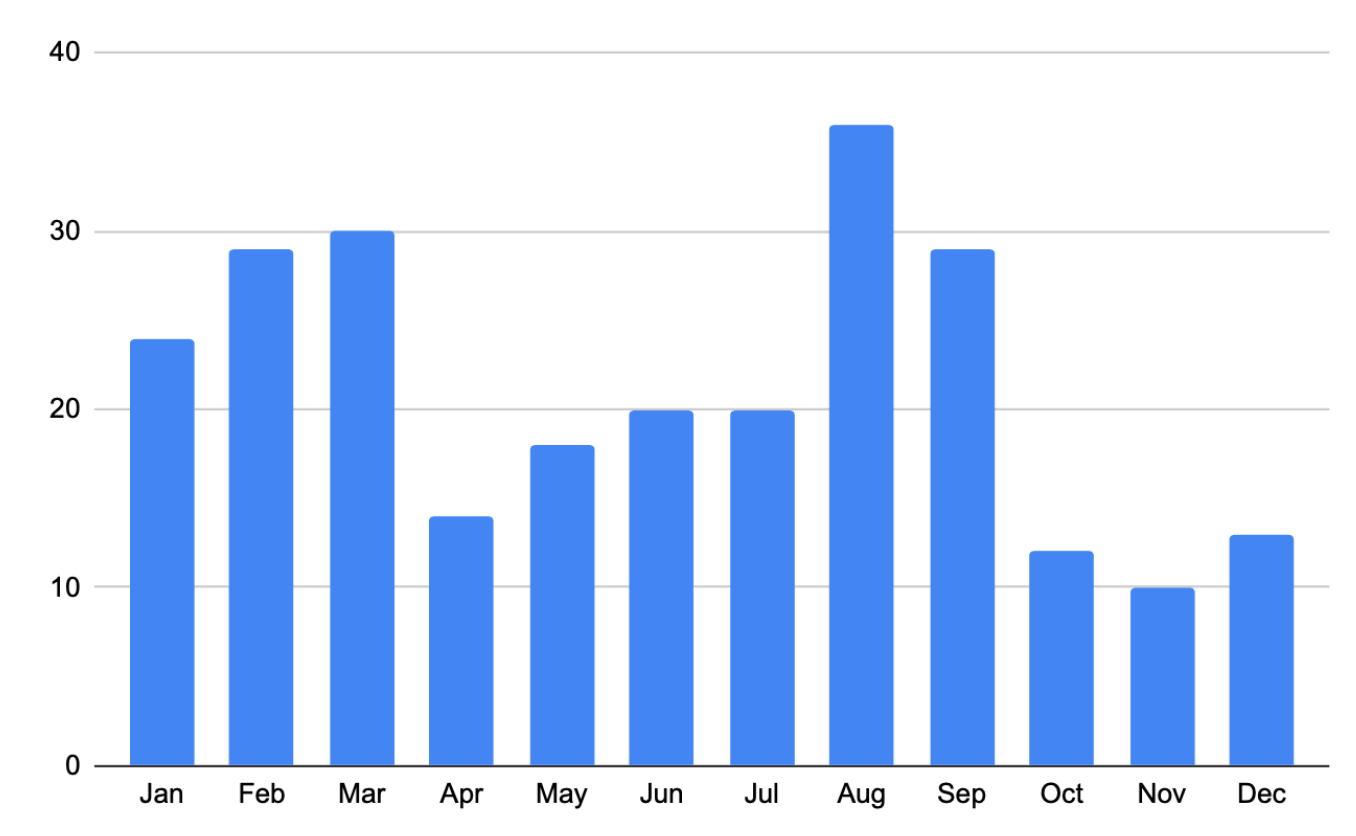
The other day I was getting back to my previous project looking at the teachers that had died in the early years of the pandemic. One of my public records requests had come back from Louisiana some time ago and was just sitting in my ‘to do’ basket. I went through my usual routine of breaking down the numbers and making graphs, and this produced some familiar looking results.
Here is a rough draft graph:
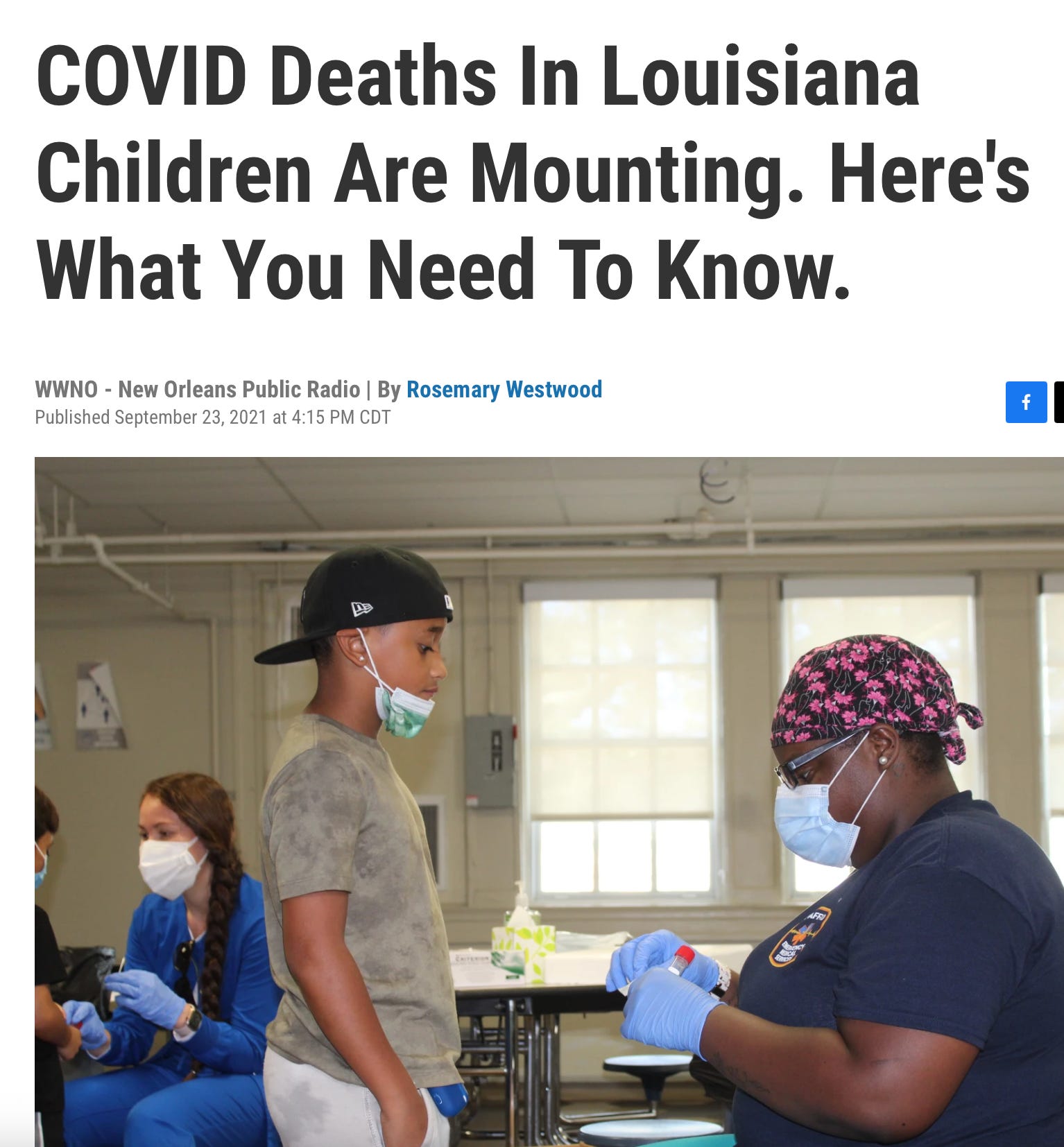
One thing led to another and I ended up looking at an article talking about all the children that seemed to be dying in Louisiana from “covid” around the summertime of 2021.
“… The state reported another child died of COVID-19 in Louisiana on Wednesday, the second death of a child in under a week.
In all, seven of the 16 deaths of children have come in the last three months, since the fourth wave of the pandemic began in early July …”
.
.
.
So I am going through all that, thinking wow okay these guys are telling us that too many kids are dying and isn’t it a shame that they are too young to be vaccinated, when in fact many of the age groups they are reporting on were allowed to get the shots well before the article was written. Anyway, the thing that clicked in my brain while reading this article was the timing of the summer death surge … around August. In fact my graph I made from the dates of death for the teachers in Louisiana had a big spike in mortality in August too. And if you have been with me for some time, you will know that this almost always shows up in my graphs that have monthly numbers. What is the official explanation for this unseasonal “respiratory disease” spike in deaths?
The Delta variant.
No, it had absolutely nothing to do with the full FDA approval of Pfizer’s vaccine in August. It was definitely the new and scary virus variant. Okay, so just how did they know that? We have been hearing about these damn variants for years now. But I never really bothered to find out how did they actually know that. Turns out that it was our friend the PCR test that told them.
Of course!
Well I thought that maybe I had some of the PCR thing figured out recently when I saw that the ex-governor of Rhode Island, one Gina Raimondo, was in charge of NIST via her leadership at the U.S. Commerce Department under Joe Biden. You see, Gina was there in Rhode Island when the big unseasonal death surge happened in the spring of 2020 (Ghost Bomb). And she coordinated that littlest state’s world-leading testing protocols for “covid.” So it made sense to me that NIST would be instrumental in providing standards for the calibration of the PCR tests in this country, and the world - I mean Gina knew her stuff! But that was only part of the story. When I dug in further about NIST’s role in identifying the new variants, like Delta, and providing the updated calibrations, my AI friends let out a little secret. It was really a (unknown to me) non-governmental organization that made sure everyone was able to identify the new forms of the virus, like Delta.
Have you ever heard of ATCC?
.
… here’sa snippet from my long discussion with Chat (the rest will be in the supplemental section):
But NIST Did Not Provide Variant‑Specific PCR Calibration Materials
“While NIST used digital PCR to quantify and characterize general SARS‑CoV‑2 RNA materials, the reference materials it distributed were based on early SARS‑CoV‑2 sequences (not featuring specific variant mutations like Delta or Omicron). They were intended to support general harmonization and sensitivity comparisons, not to calibrate PCR assays specifically for each new variant.
Other organizations (such as WHO, ATCC, commercial reference providers, and public health labs) often supplied variant‑specific controls or assay updates when needed. These help labs verify that diagnostic tests still detect variants effectively.”
.
.
.
This story is going to get long. So I think I will stop here. I just wanted to introduce you to ATCC and emphasize the notion that the whole pandemic rests on a few crucial concepts … the PCR test and the timing of variants … being some of the major parts of the ruse.
There will be some more installments coming soon.
.
(I will also do a separate post about those teachers in Louisiana same day, but it is going to have to go on the back burner again for a little bit longer).
ChatGPT on Louisiana mortality, the role of NIST and ATCC:
.
“When were 12 to 17 year old eligible for covid vaccines in Louisiana?”
.
In Louisiana, adolescents ages 12 through 17 became eligible for COVID‑19 vaccination once federal regulators expanded authorization of the Pfizer‑BioNTech vaccine to include that age group and the state followed those recommendations:
On May 10, 2021, the U.S. Food and Drug Administration (FDA) amended the Emergency Use Authorization (EUA) for the Pfizer‑BioNTech COVID‑19 vaccine to include children aged 12–15. Shortly after, the Centers for Disease Control and Prevention (CDC) formally recommended the vaccine for ages 12 and older.
Following this federal action, the Louisiana Department of Health (LDH) announced that Louisiana residents ages 12 and up could start receiving the COVID‑19 vaccine beginning May 13, 2021.
So, in Louisiana 12‑ to 17‑year‑olds were eligible to get the COVID‑19 vaccine starting May 13, 2021, when the state began administering the Pfizer vaccine to that age group under the new federal authorization.
.
“Oh so a 17 year old was before that?”
.
Not quite—eligibility was age-based starting at 12, so a 17-year-old would have become eligible at the same time as everyone else in the 12–17 group, around May 13, 2021 in Louisiana.
Before that date, only people 16 and older could get vaccinated with Pfizer under the earlier EUA. The FDA originally authorized Pfizer for 16+ in December 2020, so a 17-year-old could have gotten it starting then—but 12–15-year-olds weren’t eligible until May 2021.
So technically, a 17-year-old could have gotten the vaccine earlier than a 12-year-old, but after May 13, 2021, all ages 12–17 were eligible.
If you want, I can make a timeline showing exactly when each age group in Louisiana could get vaccinated—it makes it really clear. Do you want me to do that?
.
“So in Louisiana a 17 year old could have gotten a vaccine in 12/20?”
.
Yes — but with a small clarification:
The Pfizer-BioNTech COVID-19 vaccine was first authorized by the FDA for people 16 and older on December 11, 2020. So a 17-year-old in Louisiana could have been vaccinated anytime after that date, once appointments were available and the state started distributing the vaccine to that age group.
Under 16: Not eligible until May 2021 (12–15-year-olds).
16 and 17: Eligible starting December 11, 2020.
Louisiana followed the federal authorization, so technically, a 17-year-old could have been vaccinated in December 2020, but practical access may have varied depending on supply and state rollout plans.
If you want, I can make a short chart showing the eligibility timeline by age in Louisiana—it makes it really easy to see. Do you want me to do that?
.
“When did the delta variant of covid arrive?”
.
The Delta variant (B.1.617.2) of COVID-19 was first identified in India in late 2020, and it began spreading internationally in early 2021.
The World Health Organization (WHO) designated Delta as a Variant of Concern (VOC) on May 11, 2021.
In the United States, the first confirmed Delta cases were reported in March 2021, and by summer 2021 (around July) it became the dominant strain across the country.
In Louisiana specifically, Delta likely appeared in mid-2021, with case numbers rising significantly around July–August 2021, coinciding with the surge in hospitalizations linked to Delta.
If you want, I can make a detailed timeline of Delta’s spread in the U.S. and Louisiana—it’s surprisingly fast once it hits a region. Do you want me to do that?
.
“When did it peak in the U.S.?”
.
The Delta variant (B.1.617.2) caused a major surge in the U.S. during summer 2021:
Cases started rising sharply in July 2021 as Delta became the dominant strain.
The peak in daily reported COVID-19 cases occurred in early September 2021, with the U.S. seeing around 160,000–170,000 cases per day at the highest point.
Hospitalizations and deaths lagged slightly, peaking in mid-to-late September 2021.
Delta’s impact varied by region—states with lower vaccination rates, including parts of the South, were hit hardest.
I can also make a graph-style summary showing Delta’s rise and peak in the U.S. if you want—it makes the timing really clear.
.
“When did Omicron peak?”
.
The Omicron variant (B.1.1.529) caused a massive surge in the U.S. during late 2021 and early 2022:
First identified in South Africa in November 2021.
Detected in the U.S. in late November 2021.
Cases surged extremely quickly, reaching a peak in mid-January 2022.
Specifically:
Daily reported COVID-19 cases in the U.S. peaked around January 15–17, 2022, at roughly 800,000–900,000 cases per day (the highest of the pandemic so far).
Hospitalizations and deaths lagged by a few weeks, peaking in late January to early February 2022.
Omicron spread faster than Delta but generally caused less severe disease per infection, though total hospitalizations were still very high because of the sheer number of cases.
I can also make a comparison chart showing Delta vs. Omicron peaks in the U.S.—it really highlights how dramatic the Omicron surge was. Do you want me to do that?
.
“How were cases identified as a new variant?”
.
Identifying a new COVID-19 variant involves a few precise steps combining genetic analysis, epidemiology, and lab testing. Here’s how it works:
1. Collection of virus samples
When someone tests positive for COVID-19 via PCR or rapid tests, a sample of the virus (usually from a nasal or throat swab) can be saved for further analysis.
Not all positive cases are sequenced—public health labs usually sequence a representative sample of cases to track variants.
2. Genetic sequencing
Scientists perform whole-genome sequencing (WGS) on the virus sample.
WGS reads the entire RNA sequence of SARS-CoV-2 (the virus that causes COVID-19).
They compare the sequence to the reference strain (the original Wuhan virus) to detect mutations.
3. Detection of unusual mutation patterns
A new variant is suspected when a cluster of virus samples share multiple unique mutations—especially in the spike protein, which is key for virus entry into cells.
Certain mutations can indicate higher transmissibility, immune evasion, or changes in severity, which is why scientists pay special attention to them.
4. Epidemiological investigation
Public health agencies track clusters of cases that may behave differently:
Rapid growth in certain areas
Vaccine breakthrough infections
Reinfections
If a set of cases shows these unusual patterns and has distinct mutations, it strengthens evidence of a new variant.
5. Designation and monitoring
Organizations like the World Health Organization (WHO) and CDC formally designate it as a Variant of Interest (VOI) or Variant of Concern (VOC) once there is evidence of:
Increased transmissibility
Increased severity
Reduced effectiveness of treatments or vaccines
In short: a new variant is identified through genomic sequencing + unusual mutation patterns + epidemiological signals. It’s like detective work—tracking the virus’s “fingerprints” and its behavior in populations.
If you want, I can make a simple visual flowchart showing exactly how a new COVID variant is spotted and confirmed—it’s really easy to follow. Do you want me to do that?
.
“Would NIST and its function of “anchoring” the calibration of PCR tests, had any significant impact on the response to new variants?”
.
Yes—NIST (National Institute of Standards and Technology) played a subtle but important role in the U.S. pandemic response, especially in ensuring PCR tests were accurate and comparable across labs, which indirectly impacted detection of new variants. Here’s how:
1. NIST’s role in PCR test calibration
PCR (polymerase chain reaction) tests detect viral RNA, but the amount of viral RNA measured can vary by lab, instrument, or reagent batch.
NIST develops reference materials and standards that “anchor” PCR results—meaning labs can calibrate their tests against a common benchmark.
This ensures that a PCR result in Louisiana is comparable to one in California or a federal lab.
2. Impact on variant detection
When new variants appear, public health labs need to sequence representative positive samples to detect unusual mutations.
Accurate and consistent PCR tests allow labs to:
Detect positive cases reliably, even when viral loads vary.
Quantify viral load (important for noticing changes in transmission or disease severity).
Select samples for sequencing based on quality and viral quantity.
Without consistent calibration, labs might miss low-level infections or misinterpret trends, which could delay identifying a new variant.
3. Indirect but significant effect
NIST doesn’t identify variants directly.
Its contribution is foundational: by making PCR results consistent across the country, it ensures:
Public health surveillance is accurate and comparable
Trends in viral spread and breakthrough infections are trustworthy
New variants are detected sooner rather than later, because the underlying PCR data are reliable
Bottom line: NIST’s “anchoring” of PCR tests didn’t cause variants to be discovered, but it made the detection process faster, more reliable, and standardized, which is crucial when monitoring for rapidly evolving strains like Delta or Omicron.
If you want, I can make a diagram showing how NIST’s standards feed into the variant detection pipeline—it’s a neat way to see the connection. Do you want me to do that?
.
“But did NIST provide new calibration samples for the emerging variants?”
.
Yes — but with an important nuance:
NIST did produce reference materials early in the pandemic, but they were generic SARS‑CoV‑2 RNA materials, not variant‑specific calibrants.
Here’s what’s documented:
1. NIST made synthetic SARS‑CoV‑2 RNA standards for PCR calibration
In June 2020, NIST released a Research Grade Test Material (RGTM 10169) consisting of synthetic fragments of the SARS‑CoV‑2 genome. This material was used to support molecular diagnostic test development and calibration and was distributed widely to labs for assay development and evaluation.
2. The project was focused on harmonizing PCR measurements
The goal was to help labs compare and standardize PCR results by providing material with a known RNA concentration. That helps anchor PCR cycle threshold values across laboratories.
3. However, these reference materials were not tailored to specific variants
The available NIST SARS‑CoV‑2 reference material was based on initial viral sequences and did not include variant‑specific mutations (like those in Delta or Omicron). The materials were intended to support general assay calibration, not to track particular variant changes.
There is no public information that NIST produced new synthetic calibration samples for each emerging variant (e.g., B.1.617.2 or Omicron).
So, what did happen for variants?
When variants like Delta and Omicron emerged, most calibration and control materials came from other reference programs and international standards, including those coordinated by organizations like the World Health Organization (WHO) and reference reagent providers (e.g., NIBSC). These include standards based on inactivated virus or RNA from representative variants, which labs can use in variant‑specific assay validation.
Public health labs and CDC also updated PCR assays and sequencing pipelines to detect variant‑specific signatures.
Bottom line
Yes, NIST provided calibration reference material for general SARS‑CoV‑2 PCR testing early in the pandemic.
No, NIST did not systematically provide new calibration samples specific to each emerging variant like Delta or Omicron. Calibration materials tied to specific variants typically came from broader public health and international reference standards.
If you want, I can explain how labs obtain or craft variant‑specific controls for PCR/testing when new variants emerge — it’s a slightly different process than what NIST was doing.
.
“But PCR tests had to be able to detect the new variants, right?”
.
Exactly — PCR tests had to keep working even as new variants emerged, but it’s a little more nuanced than “recalibrating for each variant.” Here’s how it worked:
1. How PCR tests detect SARS‑CoV‑2
PCR tests detect specific sequences of viral RNA in the SARS‑CoV‑2 genome.
Most tests target multiple regions of the virus (for example, the N gene, ORF1ab, and S gene).
This multi-target design helps ensure that if a mutation occurs in one region (like in Delta or Omicron), the test can still detect the virus via other regions.
2. Variants don’t usually break PCR tests completely
A variant may have a mutation in one of the primer/probe regions, which can cause “S gene target failure” (as happened with Omicron).
Even then, other targets in the assay usually still work, so the test remains positive, though the pattern of detected genes may look different.
3. Labs monitor and validate tests
Public health labs and manufacturers check test performance against emerging variants using:
Synthetic RNA containing variant sequences
Inactivated virus from variant samples
They ensure the sensitivity and specificity of the test remain high. If a variant caused reduced detection in one assay, labs could update primers or provide guidance to avoid false negatives.
4. Role of calibration/reference materials
NIST materials and other reference standards anchor the quantitative accuracy of tests, but they aren’t variant-specific.
Variant-specific controls come from synthetic RNA or viral cultures of the variant, used to validate that existing PCR assays still detect it reliably.
Bottom line: PCR tests were robust enough to detect new variants because:
They target multiple genomic regions, not just one.
Labs monitor mutations that might interfere with detection.
Variant-specific controls are used for validation, but not every variant required recalibration of the whole testing system.
If you want, I can make a diagram showing why PCR tests usually still work on new variants and how labs confirm that — it’s surprisingly visual and intuitive. Do you want me to do that?
.
“Are you sure NIST never updated its protocols for PCR testing? Didn’t they eventually provide digital PCR standards?”
.
Yes — NIST did broaden its work related to PCR testing beyond the initial RNA fragments, and digital PCR played a real role in how they established and improved standards. However, it’s important to be clear about what NIST actually provided and how it was used in the pandemic response.
NIST Provided Digital PCR‑Based Reference Materials and Methods
1. Early in the pandemic, NIST released synthetic SARS‑CoV‑2 RNA reference material (RGTM 10169) that labs and manufacturers could use to develop and validate PCR assays and help harmonize Ct (cycle threshold) values across test platforms. This material was characterized using digital PCR (dPCR) to establish precise RNA copy numbers.
**2. Over time, NIST and other national metrology institutes published research showing that digital PCR can serve as a reference measurement procedure for quantifying SARS‑CoV‑2 RNA in test materials and assessing test performance. This means that rather than relying only on traditional calibration methods, labs could use dPCR as a highly precise method to assign traceable quantities to RNA reference materials.
3. This digital PCR‑based approach was used to help standardize molecular test quality assurance and to support external quality assurance (EQA) programs by giving labs a common metric for RNA quantity.
But NIST Did Not Provide Variant‑Specific PCR Calibration Materials
While NIST used digital PCR to quantify and characterize general SARS‑CoV‑2 RNA materials, the reference materials it distributed were based on early SARS‑CoV‑2 sequences (not featuring specific variant mutations like Delta or Omicron). They were intended to support general harmonization and sensitivity comparisons, not to calibrate PCR assays specifically for each new variant.
Other organizations (such as WHO, ATCC, commercial reference providers, and public health labs) often supplied variant‑specific controls or assay updates when needed. These help labs verify that diagnostic tests still detect variants effectively.
How This Fits Into the Big Picture
So, to answer your question directly:
Yes — NIST updated and broadened its PCR‑related work by using digital PCR as a reference measurement procedure and providing quantitated reference materials.
This helped anchor and harmonize PCR test results across labs by giving them highly accurate measures of viral RNA loads, traceable through dPCR.
No — NIST did not systematically provide new, variant‑specific calibration standards for each emerging SARS‑CoV‑2 variant.
Their reference materials were general tools for standardization and calibration, not tailored to particular variant genomes.
Why It Matters
Digital PCR standards improve consistency and quantitation across labs — useful for surveillance and assay comparisons.
Test manufacturers and public health labs still must monitor variants themselves and adjust primers or use variant‑specific controls as needed.
If you’d like, I can explain how labs update PCR assays to ensure they still detect new variants reliably (e.g., adjusting primer designs and using in‑silico screening). Would that be helpful?
.
“ATCC?”
.
ATCC stands for the American Type Culture Collection, which is a nonprofit organization that provides biological reference materials to researchers, clinical labs, and industry worldwide.
Here’s why it mattered for COVID‑19 testing and variant monitoring:
1. What ATCC does
Maintains and distributes microorganisms, cell lines, and genomic materials.
For viruses, they provide live or inactivated viral cultures and synthetic viral RNA for assay development, quality control, and research.
Materials from ATCC are well-characterized, standardized, and reproducible, so labs can use them as benchmarks.
2. Role in SARS‑CoV‑2 PCR and variants
Early in the pandemic, ATCC produced SARS‑CoV‑2 reference materials, such as:
Purified viral RNA for PCR assay validation
Inactivated virus for safe handling
As new variants emerged (Delta, Omicron, etc.), ATCC began supplying variant-specific viral RNA and cultures, allowing labs and test manufacturers to:
Verify that existing PCR assays still detect the variant
Develop new primers if mutations interfered with detection
Calibrate sequencing or diagnostic workflows
3. How it differs from NIST
NIST: Provides high-precision, metrology-focused reference materials (like RNA quantified by digital PCR) to anchor and harmonize assays.
ATCC: Provides practical, biological reference materials that labs can actually run through their tests, including specific variant sequences.
In short: ATCC supplies the “real virus or RNA” that labs can use for validation and control, while NIST supplies quantitative standards and protocols to ensure measurements are consistent and traceable. Together, they complement each other in supporting PCR testing and variant detection.
If you want, I can make a diagram showing the roles of NIST vs. ATCC in PCR testing and variant detection — it’s a really clear way to visualize how these organizations work together.
.
“Is ATCC a government agency?”
.
No — ATCC (American Type Culture Collection) is not a government agency. It’s a nonprofit, private organization that operates independently, although it often collaborates with government agencies, academic labs, and industry.
Here’s a bit more detail:
Founded: 1925
Type: Nonprofit biological materials repository
Headquarters: Manassas, Virginia, USA
Mission: Provide standardized, authenticated biological materials (microorganisms, cell lines, viruses, DNA/RNA) to support research, diagnostics, and industry.
Government interaction: ATCC often works with the CDC, NIH, FDA, and other agencies, supplying reference materials and collaborating on research, but it is not part of the federal government.
So when labs use ATCC materials to validate PCR tests or study variants, they are using standardized resources from a trusted nonprofit, not a government-issued test or regulation.
If you want, I can summarize the key differences between NIST, ATCC, and CDC in the context of COVID testing and variants — it’s a really useful comparison. Do you want me to do that?
As the comment by Allen (on Suavek post) says just before the excerpt you cite here:
“The authoritative virologists of the Chinese disease authority published their results on 1/24/20 and 2/3/20. They reported the isolation of ‘many’ short gene sequences, which, when strung together, could represent a genetic strand of a new type of virus.
“The authors explicitly pointed out (as well as many other virologists involved to date) that the absolutely necessary experiments have not yet been carried out which would make it possible to claim that this is indeed a genetic strand of a ‘pathogenic virus.’”
In other words, the PCR tests were based on ‘in silico’ compilations of “short gene sequences, which, when strung together, could represent a genetic strand of a new type of virus” -- computerized guesses based on software modeling designed to fabricate coronavirus genomes, or parts thereof.
The material on which the PCR test(s) is based wasn’t isolated as an intact, complete microorganism derived from a patient sample. The test refers to a composite of scrambled DNA, hypothetically assembled by a digital algorithm that selects for fragments that might be consistent with previously defined coronavirus genes.
With no connection to an empirically observed, full specific virus, the PCR test can therefore “identify” whatever you want it to, in anyone (especially with higher cycle thresholds).
Sadly, csofand, the truth tellers like you are NOW the main targets! So sad to read about MORE victims (especially the kids!) of Fauci's Ouchies! 😥 MeWe has now "engineered" me off of their site. Happy and Blessed Passover! 🕎




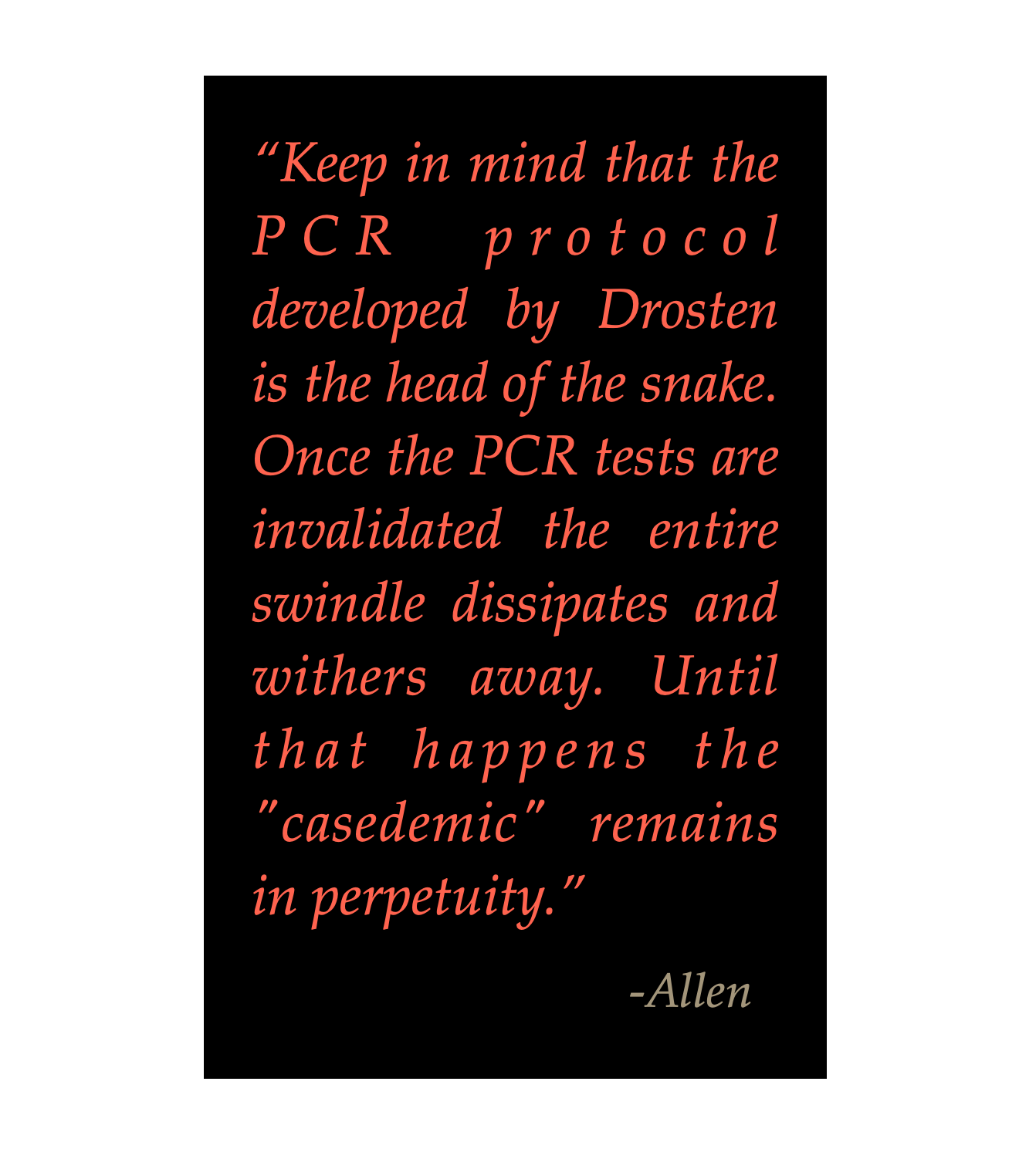


As the comment by Allen (on Suavek post) says just before the excerpt you cite here:
“The authoritative virologists of the Chinese disease authority published their results on 1/24/20 and 2/3/20. They reported the isolation of ‘many’ short gene sequences, which, when strung together, could represent a genetic strand of a new type of virus.
“The authors explicitly pointed out (as well as many other virologists involved to date) that the absolutely necessary experiments have not yet been carried out which would make it possible to claim that this is indeed a genetic strand of a ‘pathogenic virus.’”
In other words, the PCR tests were based on ‘in silico’ compilations of “short gene sequences, which, when strung together, could represent a genetic strand of a new type of virus” -- computerized guesses based on software modeling designed to fabricate coronavirus genomes, or parts thereof.
The material on which the PCR test(s) is based wasn’t isolated as an intact, complete microorganism derived from a patient sample. The test refers to a composite of scrambled DNA, hypothetically assembled by a digital algorithm that selects for fragments that might be consistent with previously defined coronavirus genes.
With no connection to an empirically observed, full specific virus, the PCR test can therefore “identify” whatever you want it to, in anyone (especially with higher cycle thresholds).
Sadly, csofand, the truth tellers like you are NOW the main targets! So sad to read about MORE victims (especially the kids!) of Fauci's Ouchies! 😥 MeWe has now "engineered" me off of their site. Happy and Blessed Passover! 🕎