
Tragic Mountain
COLORADO and the Ghost Bomb Mob


.
***So again, at the risk of trying some of my long time readers’ patience, I will say what this Ghost Bomb series is all about for any newcomers.***
In the spring of 2020 there were some places in this country that saw very unseasonal increased mortality.
In the following year (fiscal year 2021) many of these same places had huge windfalls in their public employee pension plans due to historic investment gains.
These investment gains were happening simultaneously with additional increased member mortality into 2021 and beyond.
A look back at the solvency of these same state pension plans show that many of these locations that had the strange 2020 spring death surge were in pretty bad financial shape in the years before the pandemic hit.
Previously I pointed out that in those 14 U.S. state locations (*plus Wash. D.C.*) that saw this big spring mortality spike, there were six that also showed up in the bottom ten of the worst pensions of 2019.
Since I have dubbed that April/May death surge the “Ghost Bomb,” those places were then called the Ghost Bomb Six.
But that name had to change … you see, the group is expanding.
.
.
.
The group formerly known as the Ghost Bomb Six is now going to be referred to as the Ghost Bomb Mob.
It’s open ended.
After my last post which brought little Rhode Island into the fold, we have now identified 8 of the 14 state ghost bomb locations as also being in the bottom of all bad pensions in the country pre-pandemic.
.
Total Ghost Bomb list (14 states + D.C.):
Colorado
Connecticut
Delaware
District of Columbia
Illinois
Indiana (baby bomb)
Louisiana
Maryland
Massachusetts
Michigan
New Jersey
New York
Pennsylvania
Rhode Island
Virginia (baby bomb)
.
.
.
Current Ghost Bomb Mob:
.
Today I am going to attempt to make the case for yet one more.
.
Colorado?

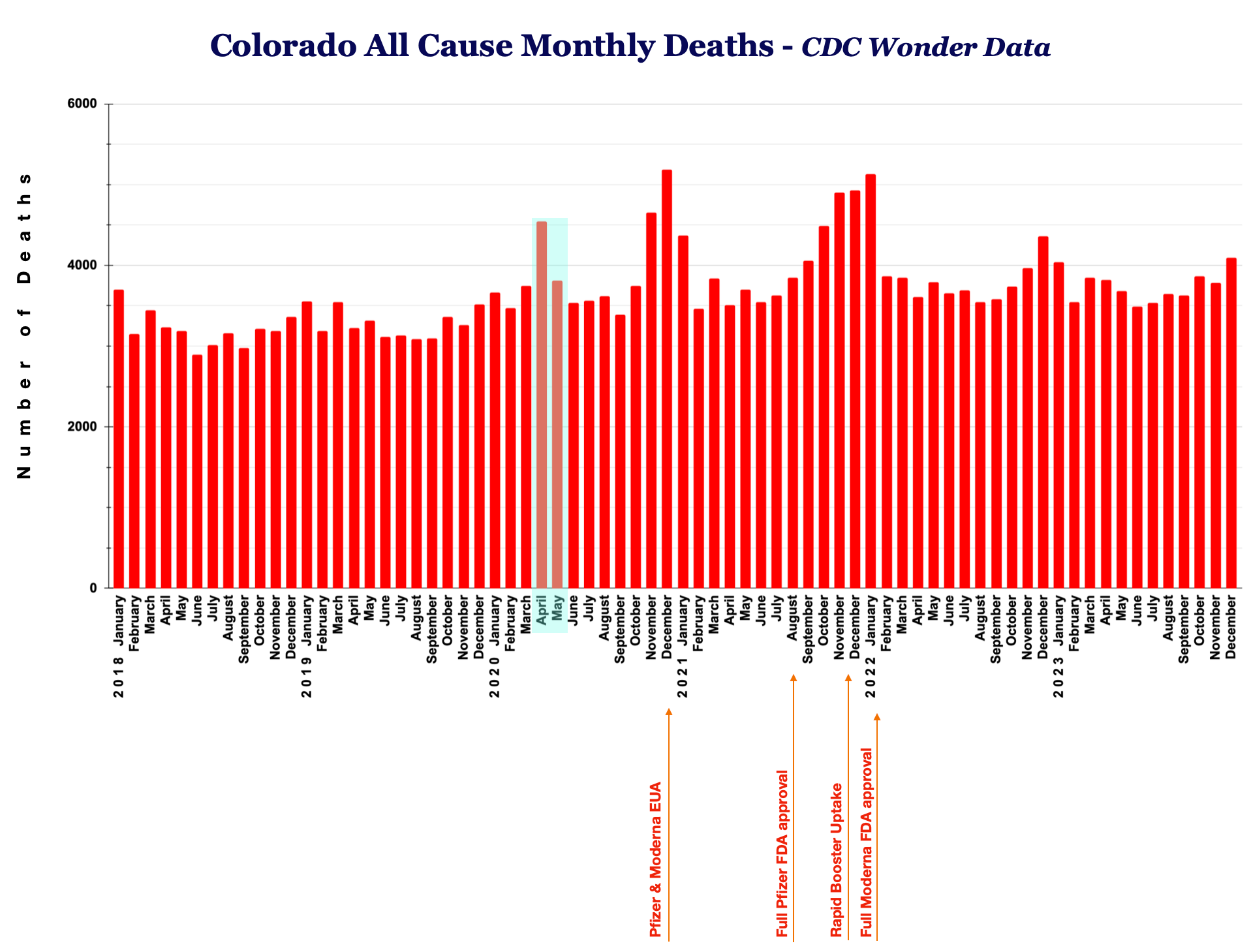
(ghost bomb in blue highlight)
.
.
.
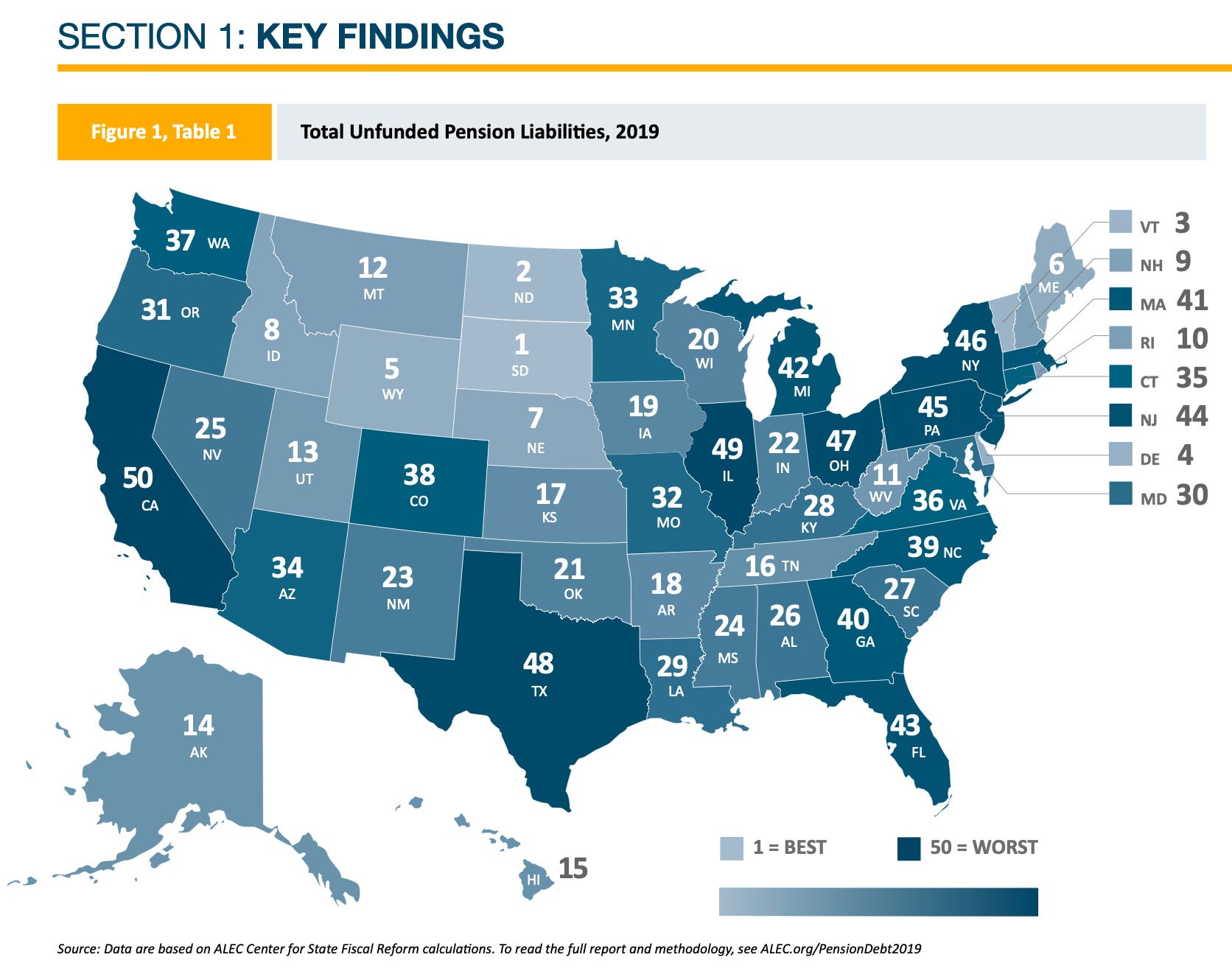
As we have been talking about in the last couple of installments, my original source of pension rankings (ALEC) is not the only one out there. ALEC had Colorado ranked at #38, and that is why it was not in the original Ghost Bomb Six - since I was only looking at the bottom ten ranked pensions.
But even that (13th worst) is a pretty poor rank.
.
But are there other sources that actually bump it down in the bottom ten?
Let’s see what some other folks had to say about Colorado’s biggest public pension system, PERA (Public Employees Retirement Association) at the time.
.

July 16, 2019
“When it comes to pension funds, returns are one thing, but volatility matters, too. And chasing higher returns increases their volatility, effectively reducing those returns over time. Pension funds typically pay out more in benefits than they take in via contributions. Therefore, these reduced returns are especially costly when trying to recover from underfunding; investment returns must not only make up that difference, they must also help replenish Net Assets. Bad years hurt more than good years help.
Let’s look at how much that volatility costs, and how much it has cost Colorado’s Public Employees Retirement Association (PERA) in particular since 2000 …
… The following chart compares the arithmetic average returns and volatilities since Fiscal Year 2001 of 150 distinct public pension funds tracked by the Center for Retirement Research at Boston College. The data includes the latest fiscal year, whether 2017 or 2018.
As expected, volatility increases with returns, with considerable variation in volatility even in funds with comparable returns. The red dot is PERA; its volatility is among the highest for funds with similar returns …”
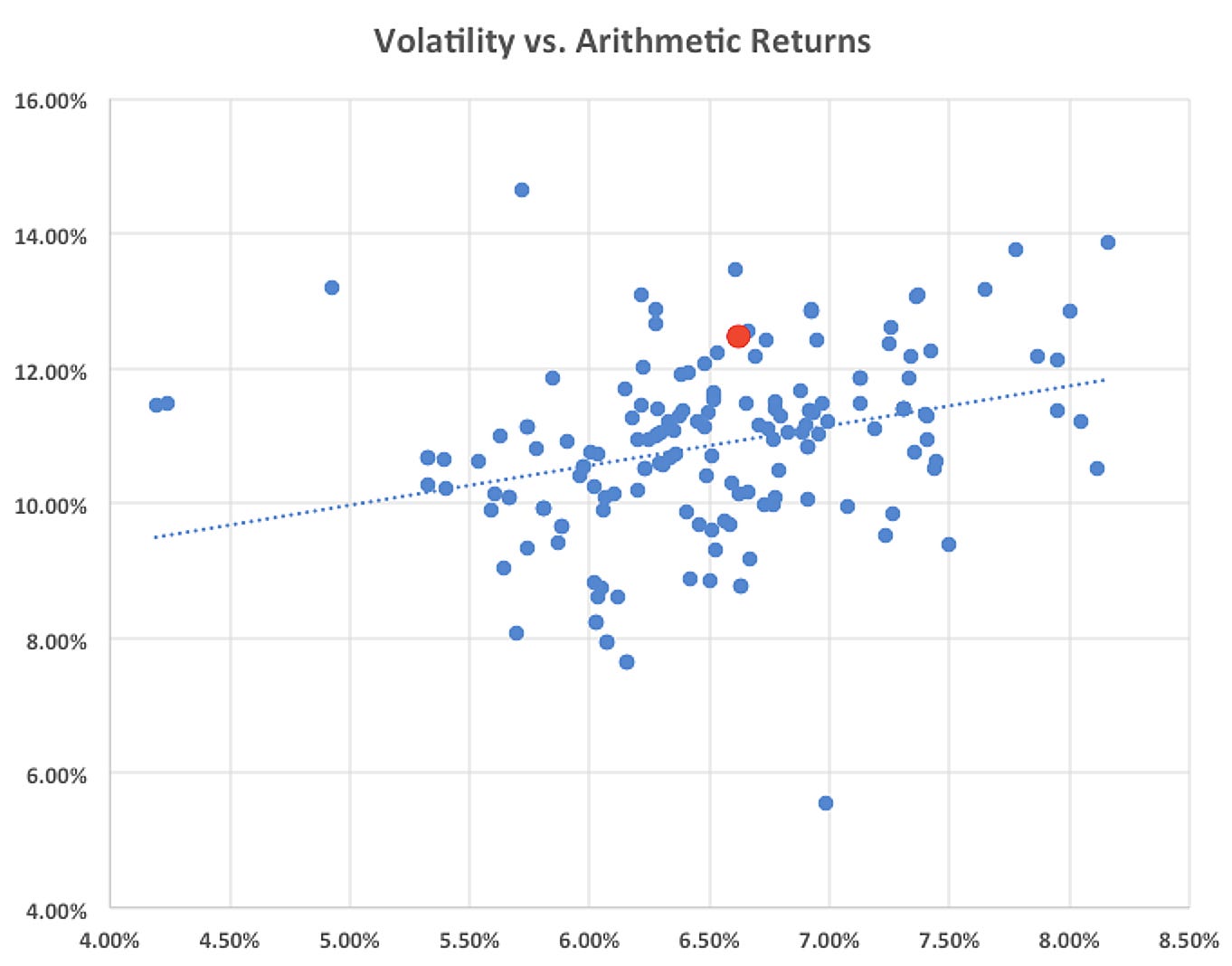
“… Because PERA is underfunded, they need to make up the annual difference between contributions and benefits and help replenish the Net Position. Since bad years hurt more than good years help, and since greater volatility increases both the frequency and severity of bad years, volatility is the enemy of long-term solvency.”
.
.
.
October 15, 2019
“Colorado future retirees have the fifth-worst managed pension fund in the country, which puts their benefits at risk, reports financial news website 24/7 Wall St.
24/7 Wall St. reviewed the rank of severity of each state’s pension crisis.
Colorado came in fifth.”
.
.
.
June 27, 2019
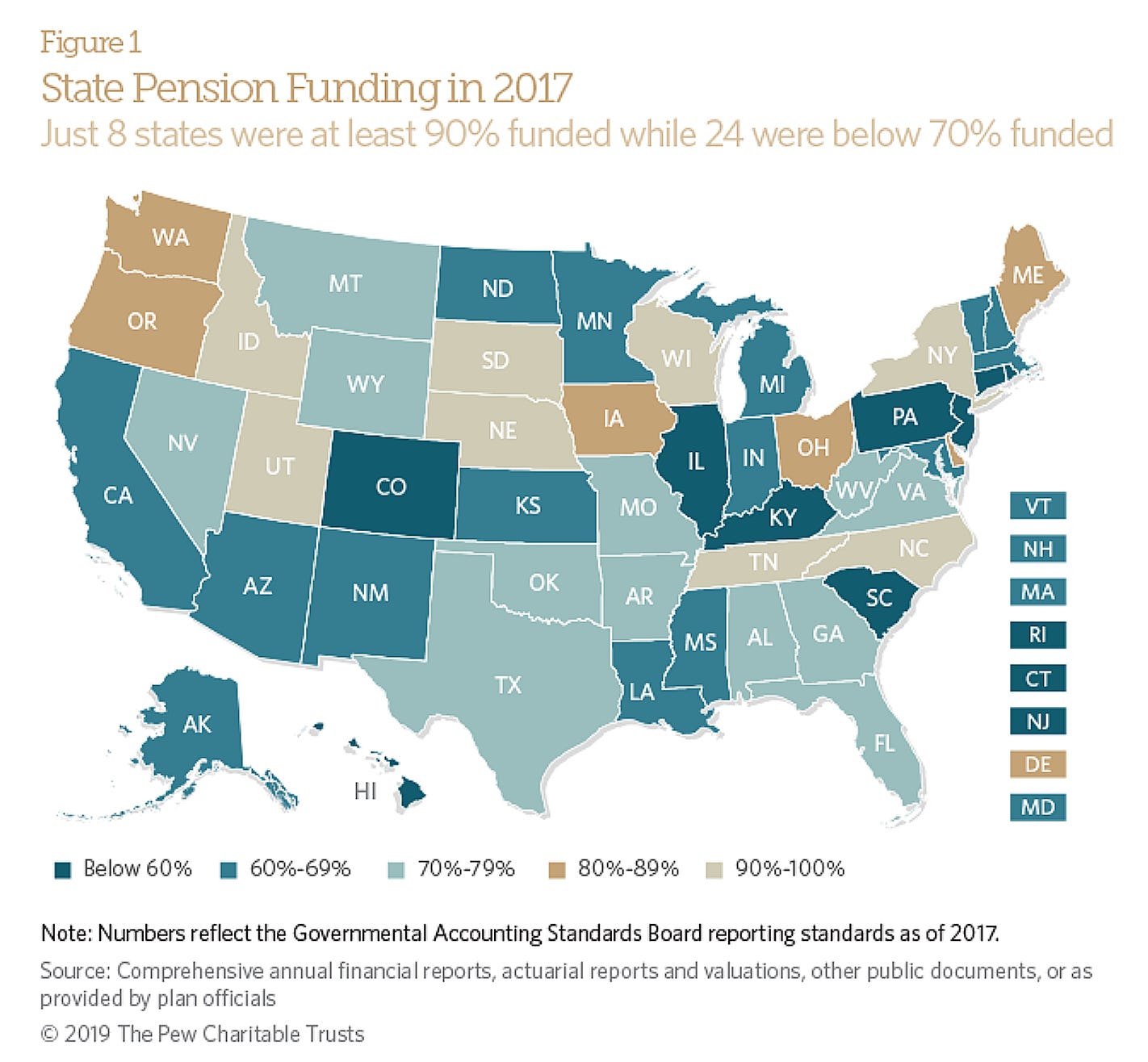
“… Overall in 2017, states had 69 percent of the assets they needed to fully fund their pension liabilities—ranging from 34 percent in Kentucky to 103 percent in Wisconsin. In addition to Kentucky, four other states—Colorado, Connecticut, Illinois, and New Jersey—were less than 50 percent funded, and another 15 had less than two-thirds of the assets they needed to pay their pension obligations …
.
*(eerily similar to the ALEC map is this next one. Notice that a darker color is also a bad sign here (that means below 60% funded). A lot of our Ghost Bomb Mob is pretty dark here on this Pew map too. Colorado is the closest we will get to a West Coast ghost bomb).
.
.
.
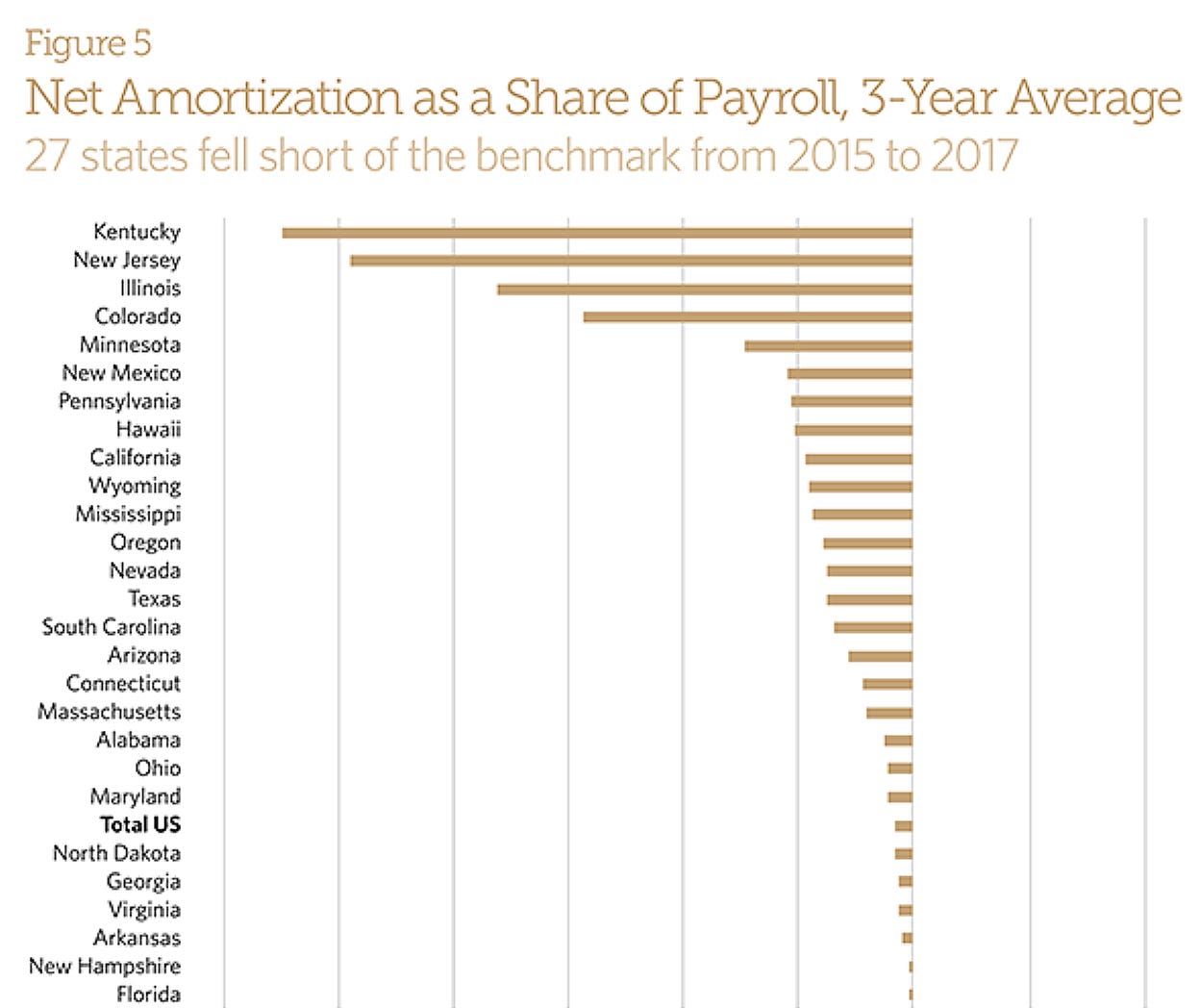
*on the next chart Colorado is 4th worst.
.
.
.
*and again, on the next chart Colorado is 4th worst.
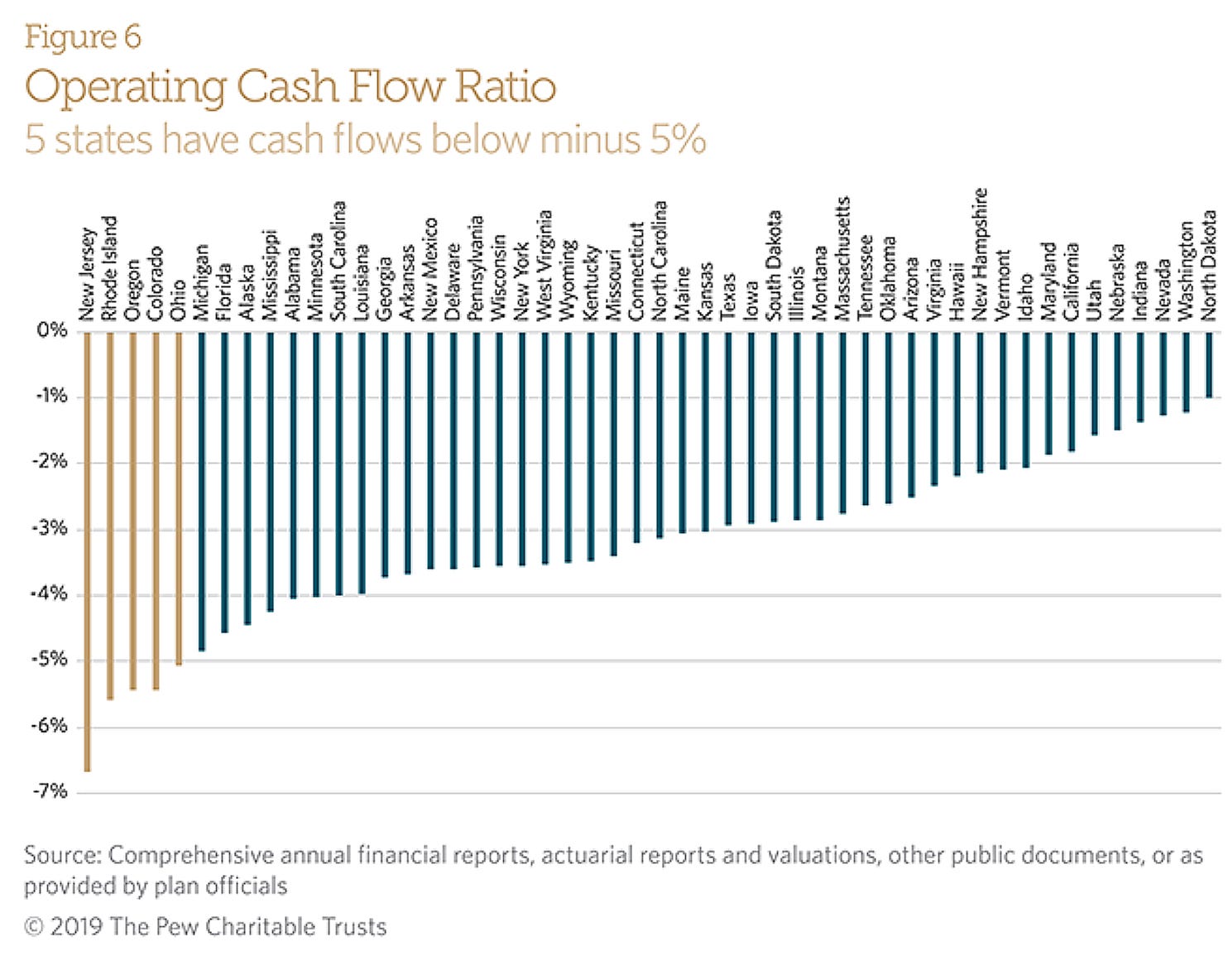
“… The operating cash flow ratio is particularly useful in highlighting plans that are most at risk of fiscal distress. For example, New Jersey, Rhode Island, Oregon, Colorado, and Ohio had operating cash flow ratios below minus 5 percent in 2017. The asset levels of these states will drop if investment returns fall below 5 percent, a likely downside scenario. A continued operating cash flow ratio below minus 5 percent thus represents an early warning sign of potential fiscal distress and a substantial risk of insolvency over time if policies are not enacted to mitigate it …
… A stress test analysis conducted for the Colorado Public Employees’ Retirement Association found a risk of future negative cash flow depleting plan assets under current policy—culminating in a 1 in 4 chance of effective insolvency.”
.
.
.
So what do you think? Have I made a case for Colorado to be in our bad pension gang leading up to covid? I mean, if you won’t take Pew’s word for it, then I don’t know what I can do to convince you.
.
.
.
The Big Payday

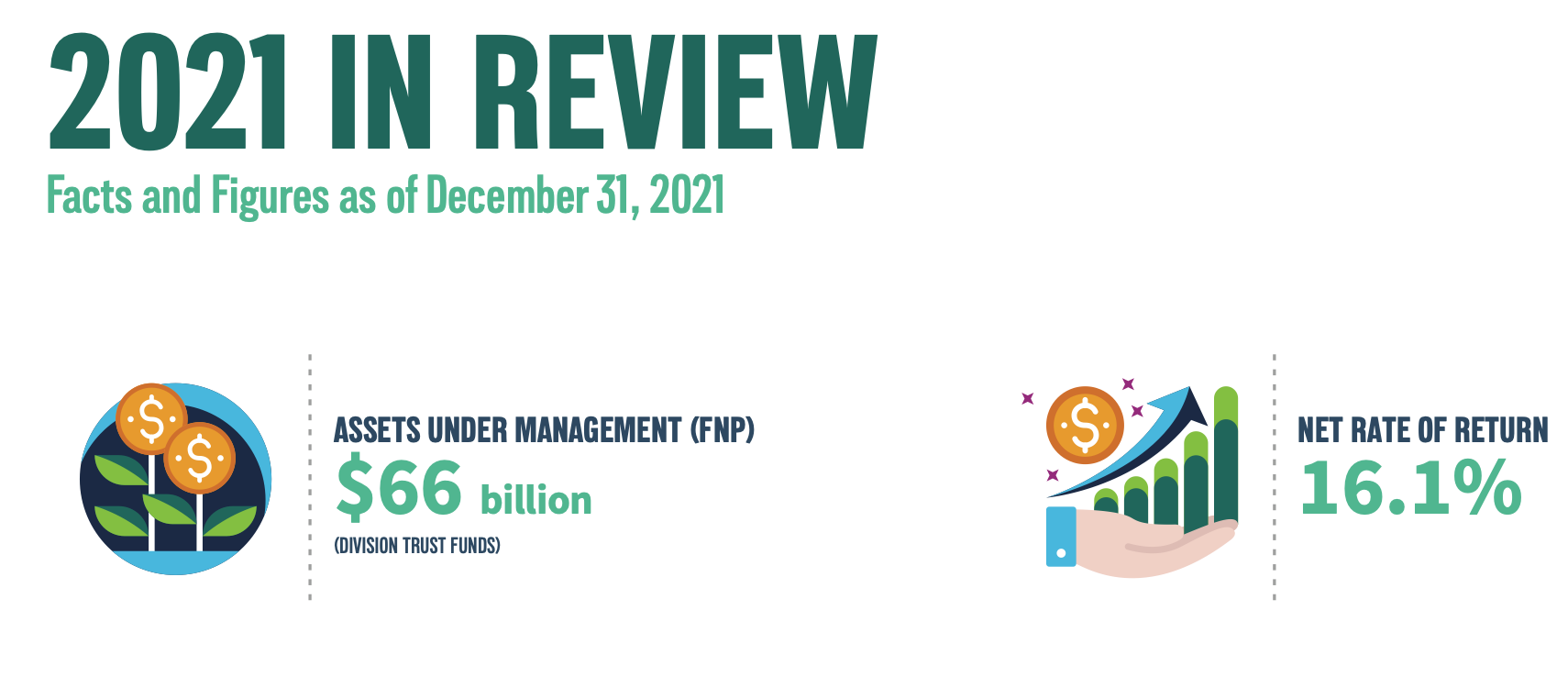
I am not sure if these investment returns we will see next for PERA are going to seem impressive to you or not. In comparison to some of the other returns we have seen, say like the number one performance (38.4 %) by Delaware, the 16.1% return may seem paltry. But that is only because those others were in most cases “historic” in magnitude.
All that gum flapping aside, PERA did very well with that 16.1%.
.
Right?
.
.
.
(link)
.
.
.
The next news story I will share is actually discussing PERA’s great investment returns in 2019. But I think there are some interesting things said in it that are very relevant to what we will see later.
.

June 22, 2020
“… Nonetheless, 2019’s financial performance was a rare cause for celebration for the beleaguered pension system, which relies on a mix of investment returns and employee and taxpayer contributions to fund the benefits of more than 628,000 members. If nothing else, the banner year puts PERA on more stable footing as it braces for the financial difficulties ahead …
… Through March 2020, PERA officials said they had lost 11% on their investments, which would represent its worst investment year since the fund dropped 26% in 2008 …
… But with more budget cuts expected next year, lawmakers may not be done with PERA …
… On Friday, Board Chairman Tim O’Brien praised lawmakers for heeding PERA’s message during its recent budget discussions: “You’re gonna pay me now or you’re going to pay me later. And it’s going to be more if you pay me later.” ”
.
.
.
And a follow up story by the same author a year later …
.
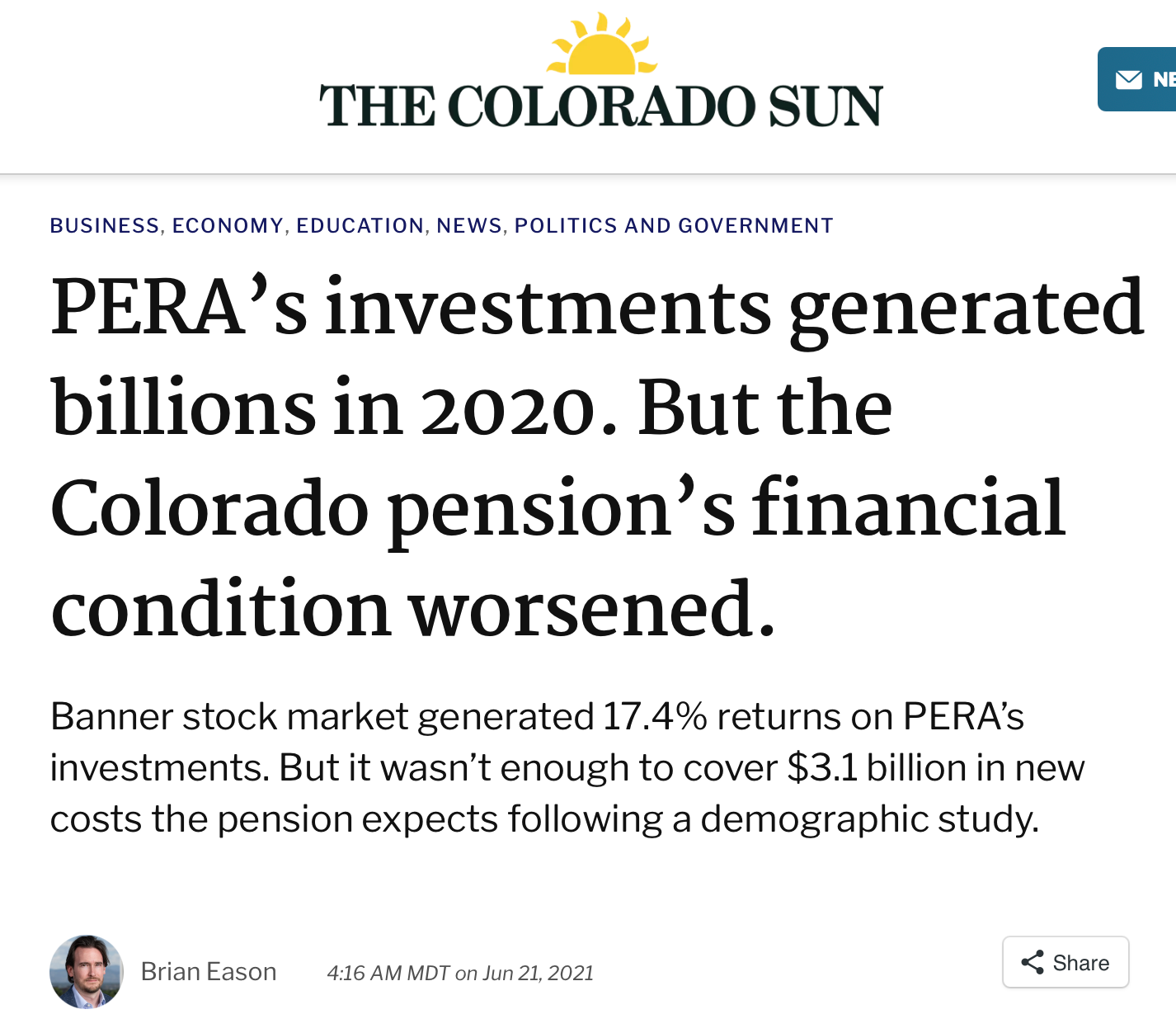
June 21, 2021
“… Despite a banner stock market year that saw Colorado’s Public Employees’ Retirement Association generate 17.4% returns on its investments — more than double its target — the state’s public pension still ended 2020 in worse financial shape than it started …
… The deteriorating funding means public workers and the government agencies that employ them will have to contribute more, and retirees will receive less starting in July 2022. These changes are the latest ripple effect of the 2018 pension overhaul that automatically adjusts contributions and benefits whenever the pension’s funding veers off course.
The main culprit this time around wasn’t an economic shock; PERA actually weathered the pandemic in decent shape, thanks to surging stock prices …”
.
.
.
Now this next one is an opinion piece by an author named Eric Sondermann. I do not know who that person is and have no background to share, but there are some thought provoking statements. You be the judge.
.

July 11, 2021
“… This bad news, even with investments going gangbusters, means that PERA retirees will see their cost of living adjustment reduced just as inflation looms, and both public employers and employees will put even more into propping up a precarious system …
… None of this even begins to address the financial calamity that will befall PERA with some medical advancement that extends life expectancy. We are unlikely to awake to a single, momentous headline announcing, “Cancer cured.” Progress will be more incremental. But when the happy day comes that we have a cure for even just one common cancer, all of PERA’s actuarial tables go out the window …
… A few years back, newscaster Kyle Clark interviewed former Democratic Governor Dick Lamm and posed the simple question, “What is the one issue Colorado is ignoring at its peril?” Lamm’s response: “Our public pension system, PERA.” “
.
“… None of this even begins to address the financial calamity that will befall PERA with some medical advancement that extends life expectancy.”
.
.
.
Unexpected Mortality

.
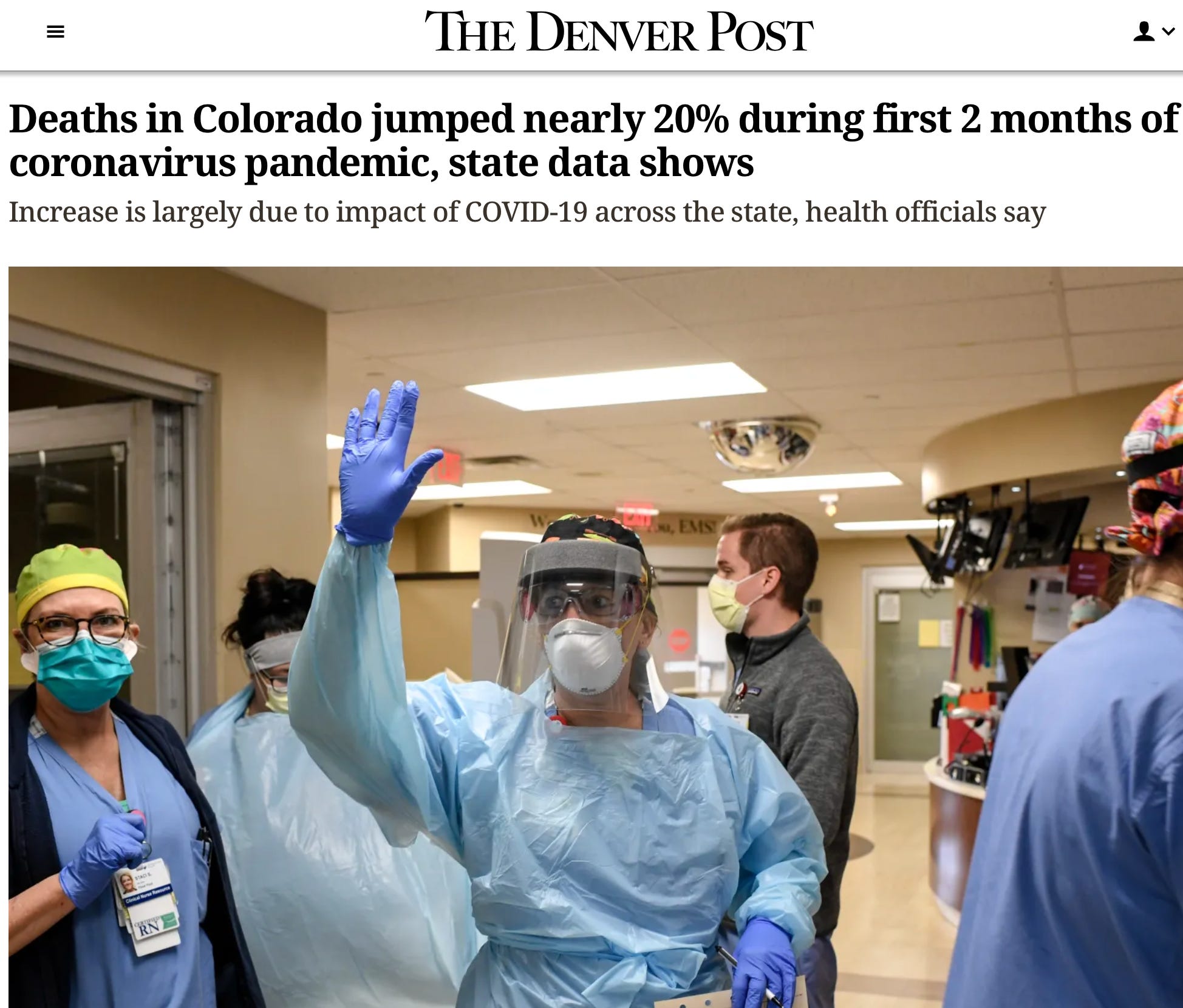
May 15, 2020
“… Colorado recorded a nearly 20% increase in deaths in March and April as the novel coronavirus swept the state, according to state data that provides an early glimpse of the broader impact of the pandemic …
…But the increases in March and April were more significant. In 2019, 6,761 people died in Colorado during those two months, but this year the number of deaths in that same time frame increased by 1,341 to an estimated 8,102 deaths. But there’s a lag in death certificate data, meaning the number of deaths in April could still rise further.”
.
.
.
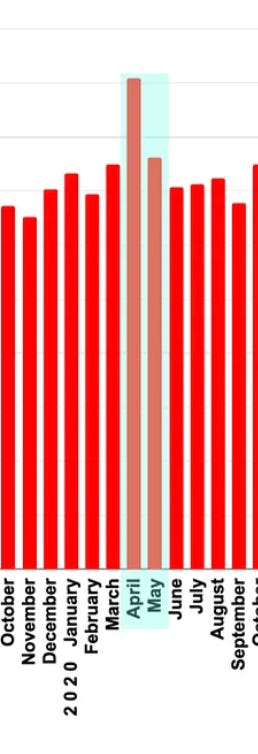
*If you are curious, you can go look at my old post about this pension system. It was one of the first that I ever did and it has a very different look to it from much of my later work on this topic. There you will see my fledgling attempts at visualizing the data … could be interesting.
.
.
.
Now, let’s look at the annual report from 2021.
.
PERA Annual Comprehensive Financial Report
for Fiscal Year Ending December 31st, 2021
.
.
page 170 (Schedule of Gains and Losses in Accrued Liabilities)
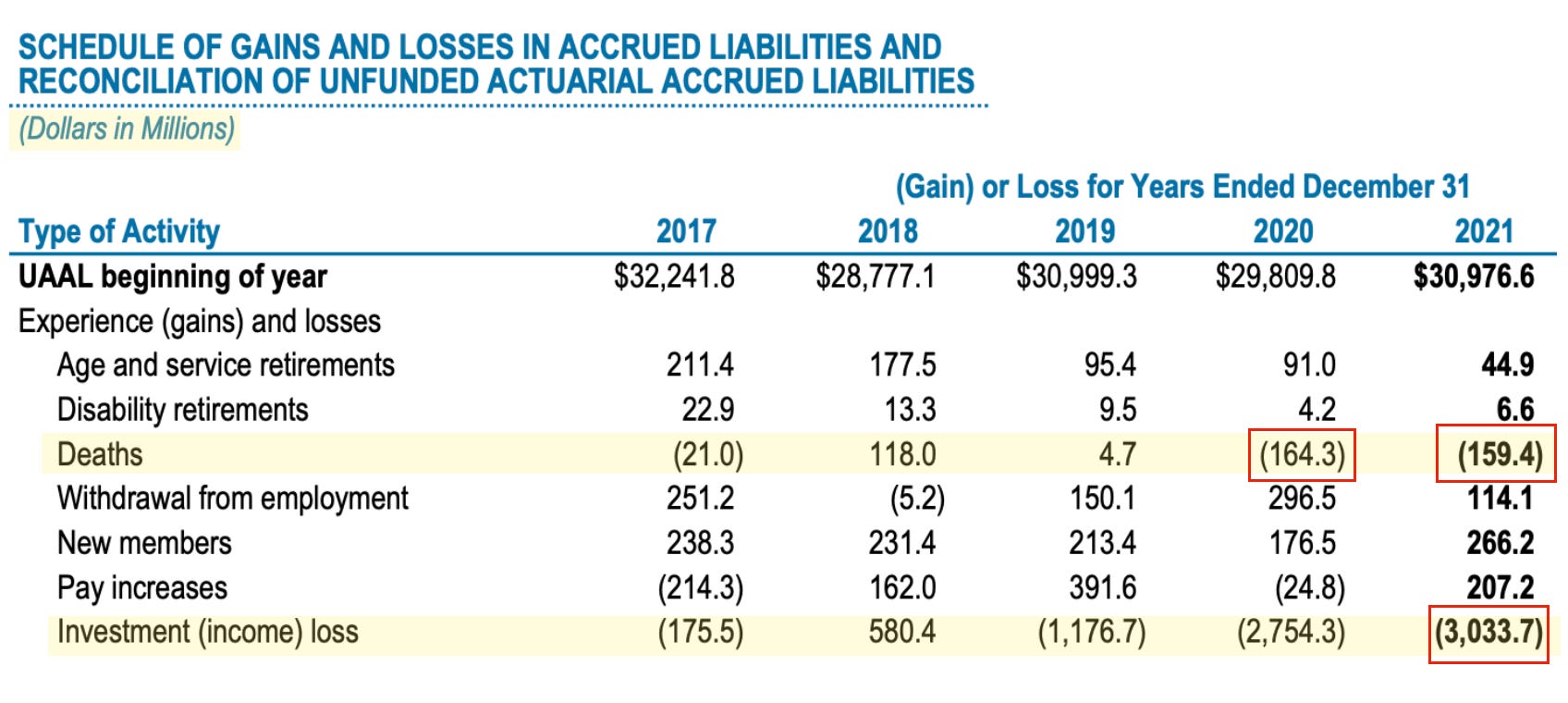
*(So please notice that these years are calendar years, and the report ends on December 31st).
This is one of those charts that uses parentheses to show a gain. If it is in parentheses on that “Death” line, then it is more people dying than expected.
So for “Deaths” why would you see almost as much of a gain for the excess deaths of members in 2021 as 2020? The Ghost Bomb went off in 2020. And all of 2021 was graced with the life saving vaccines, after all. Where is the evidence here that they made any difference?
I don’t see it.
.
.
But next, let’s jump forward and look at the most recent annual report and see what has been happening since.
.
PERA Annual Comprehensive Financial Report
for Fiscal Year Ending December 31st, 2024
.
.
page 172 (Schedule of Gains and Losses in Accrued Liabilities)
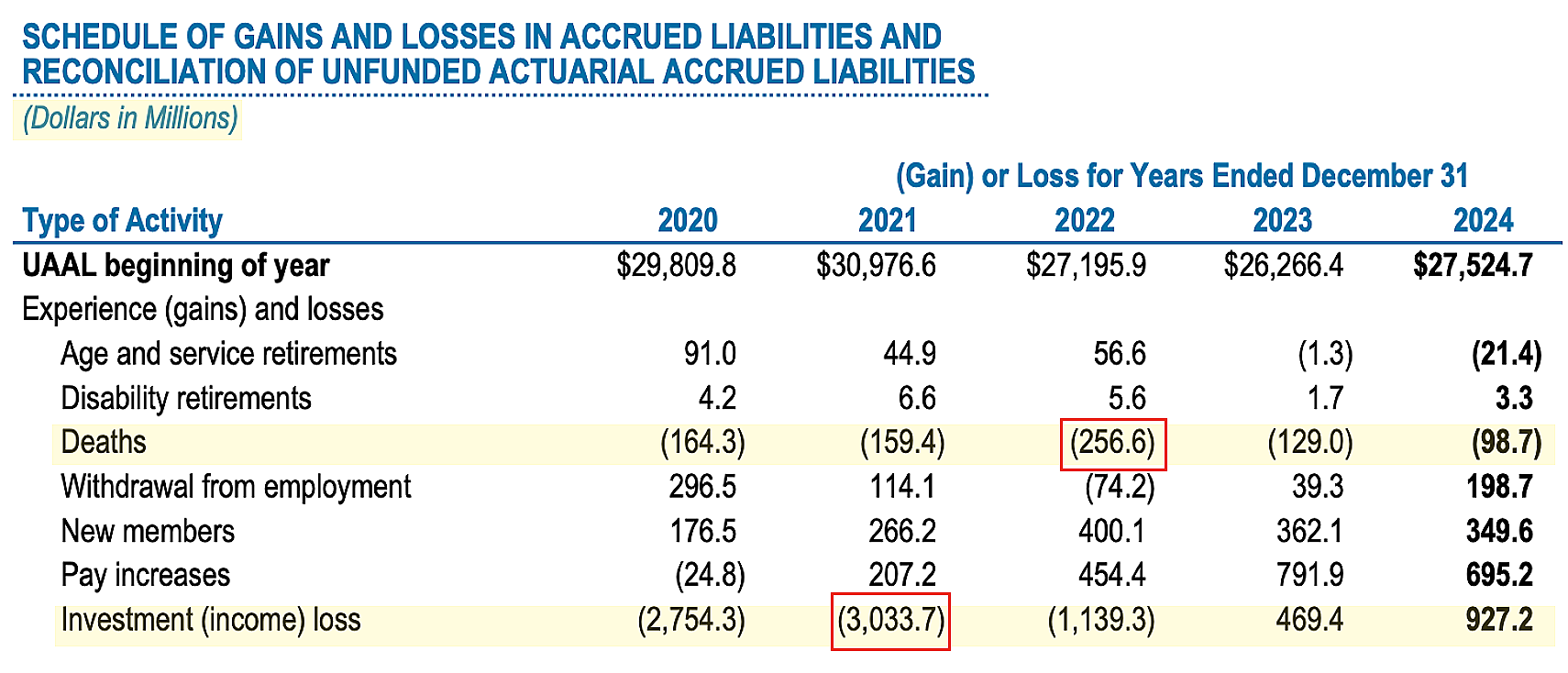
***All the subsequent years on the “Deaths” line are in parentheses. That means more people dying than they expected. Look at that figure for 2022!
.
Let’s visualize that …
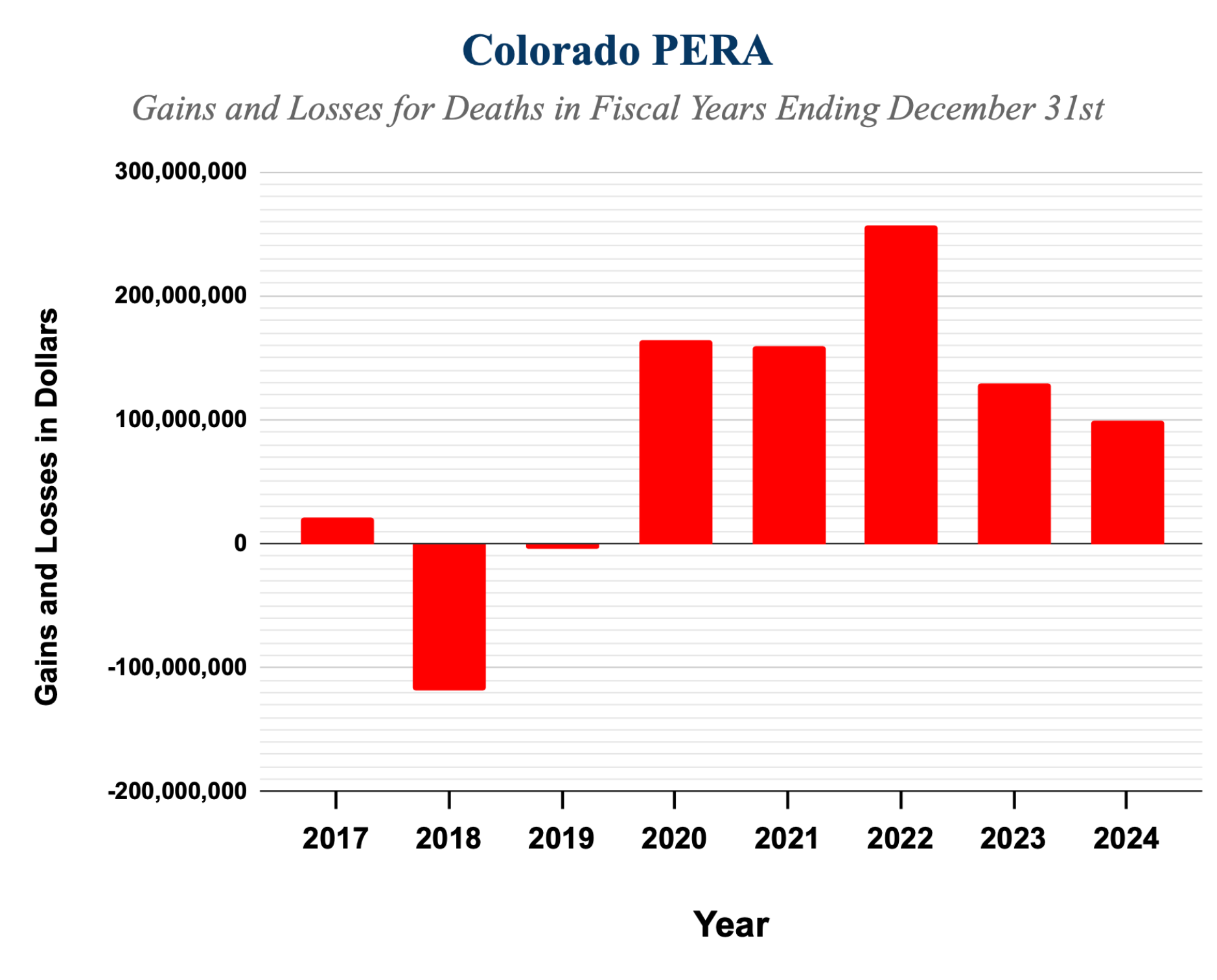
One more time.
Everything hanging down under the zero line means that less people died than they thought. And then everything above that zero line means more people dying than they expected.
.
.
.
We are not even close to being done with this 2024 annual report though folks.
.
pages 180 & 181 (SCHEDULE OF RETIREES, BENEFICIARIES, AND SURVIVORS ADDED TO AND REMOVED FROM THE BENEFIT PAYROLL)
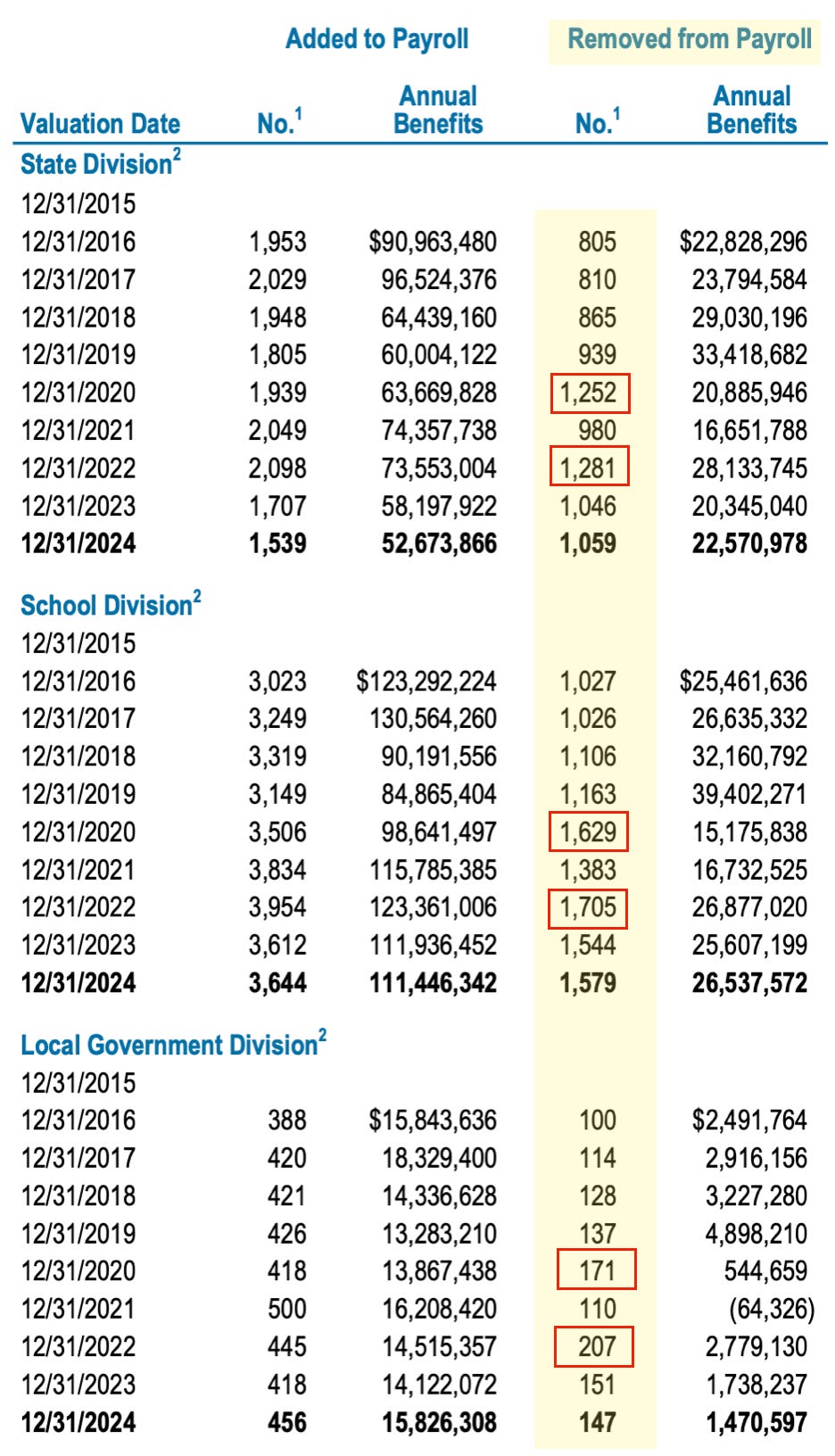
*there are a few other subgroups, but let’s just go to the numbers for all of them combined.
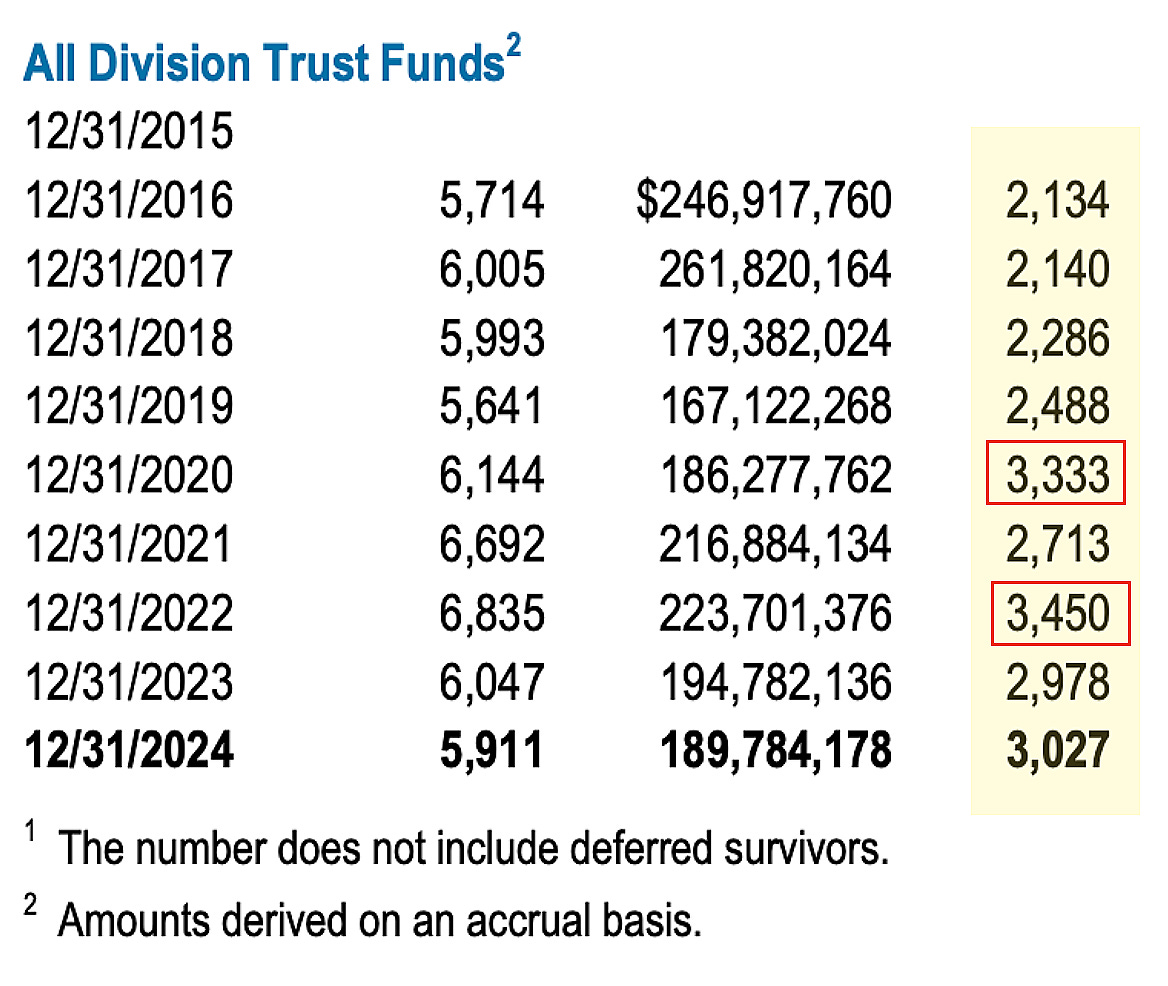
.
.
.
How is that vaccine working for you there in 2022?
.
The Ghost Bomb goes off in 2020, and yet even with the miracle drug we have more people being removed in 2022.
Hmmm … curious.
.
.
.
page 199 (HEALTH CARE TRUST FUNDS—OPEB / Actuarial Gains and Losses)
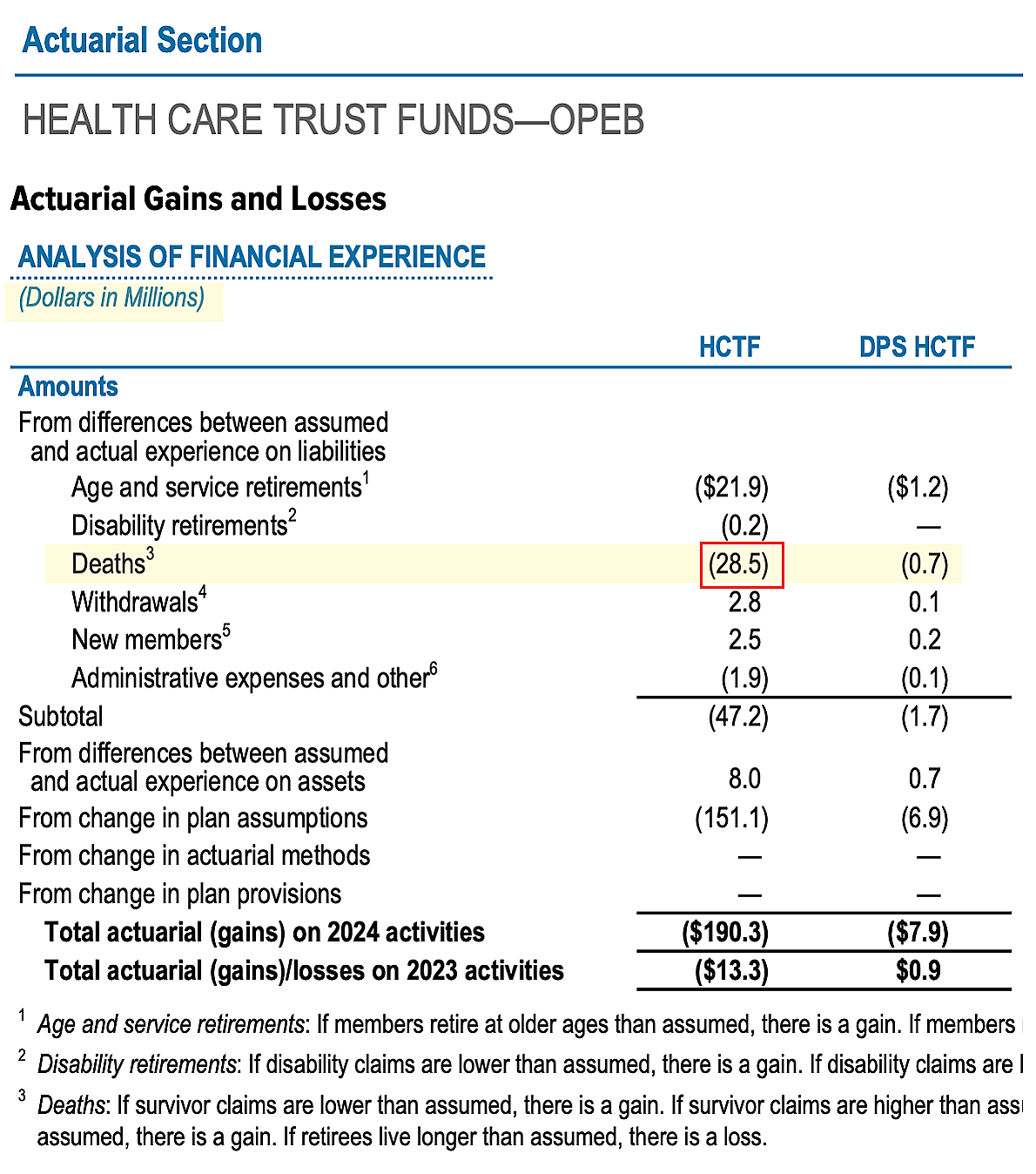
*So in this Other Post Employment Benefits (OPEB) table for health care we are seeing yet more evidence of increased mortality well into 2024. The footnote for Deaths was cut off in the screenshot, so I will give you the entire text from footnote #3 here:
3 Deaths: If survivor claims are lower than assumed, there is a gain. If survivor claims are higher than assumed, there is a loss. If retirees die sooner than assumed, there is a gain. If retirees live longer than assumed, there is a loss.
.
That’s right … a parentheses means a gain.
.
$28 and a half million dollar gain.
.
.
.
page 204 (HEALTH CARE TRUST FUNDS—OPEB / SCHEDULE OF RETIREES, BENEFICIARIES, AND SURVIVORS ADDED TO AND REMOVED FROM THE BENEFIT PAYROLL)
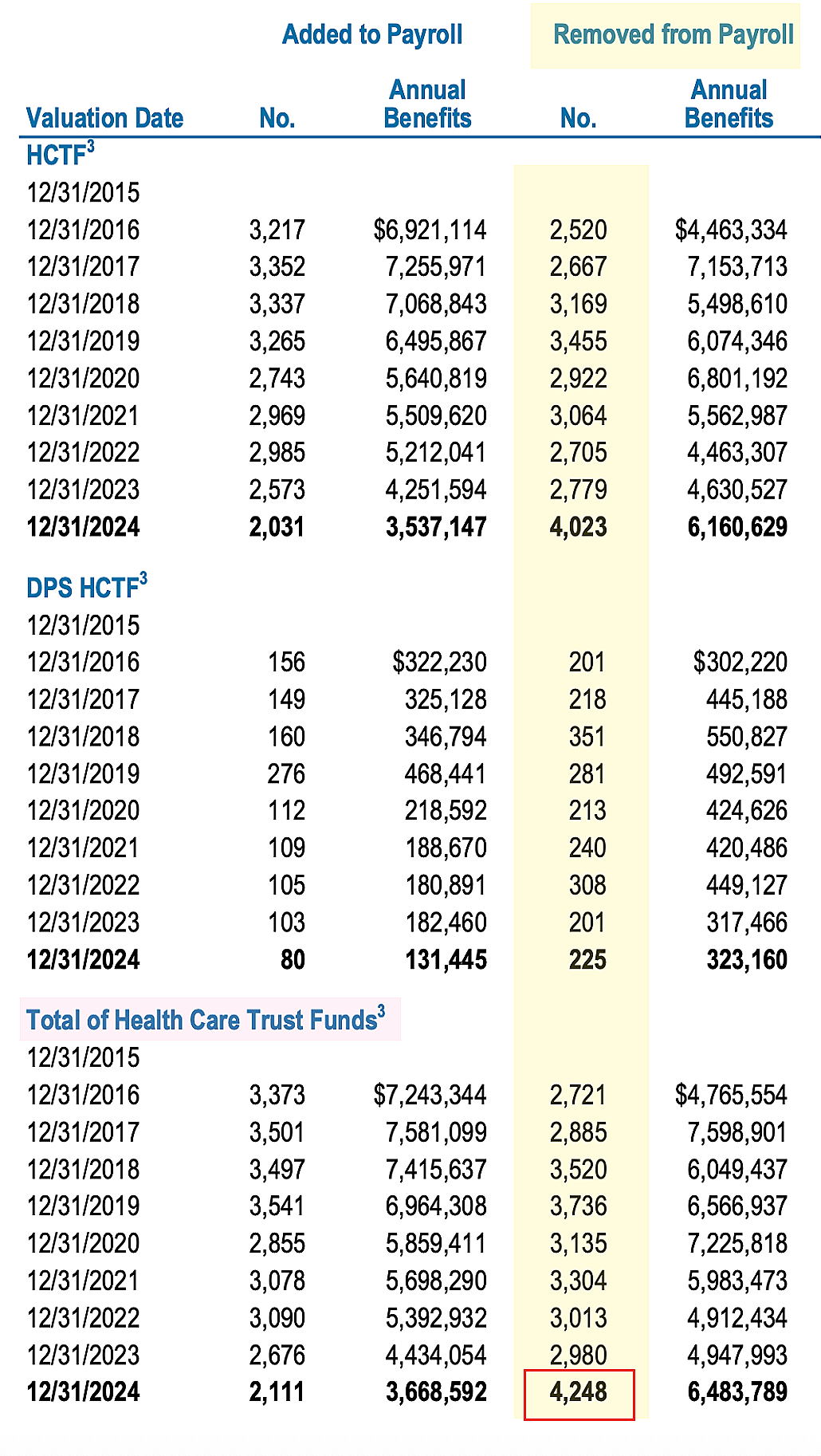
.
2024 is going the wrong direction.
.
.
.
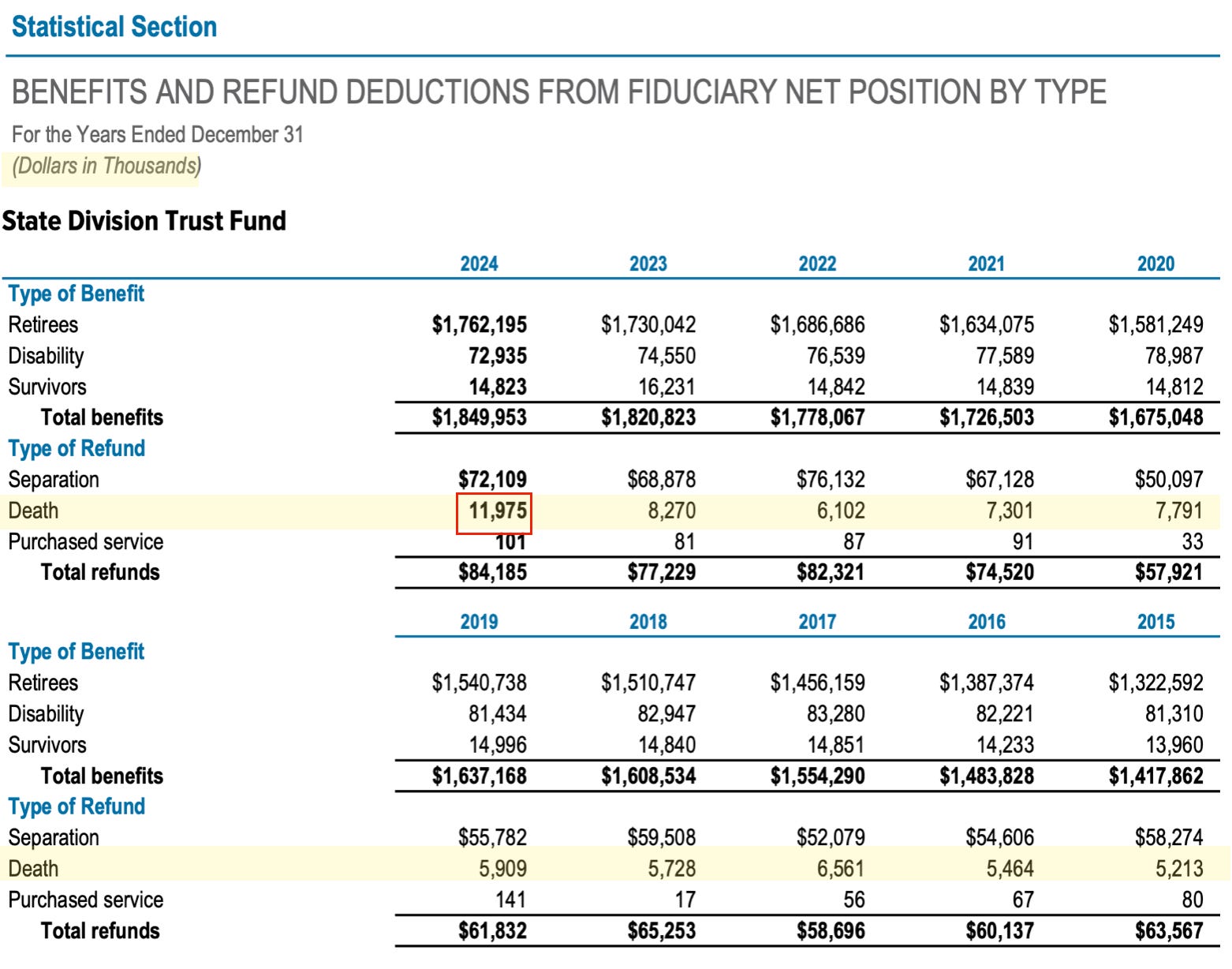
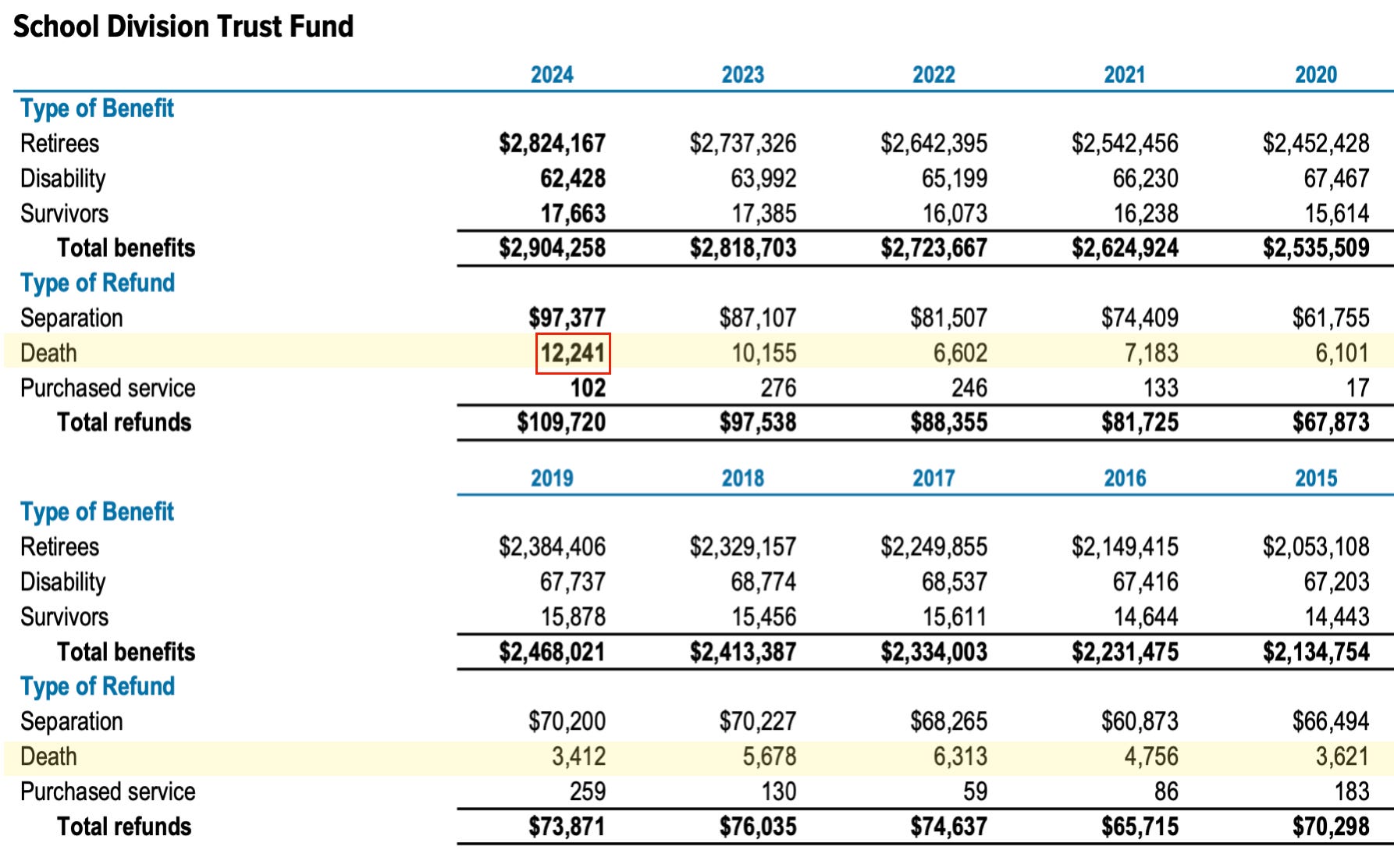
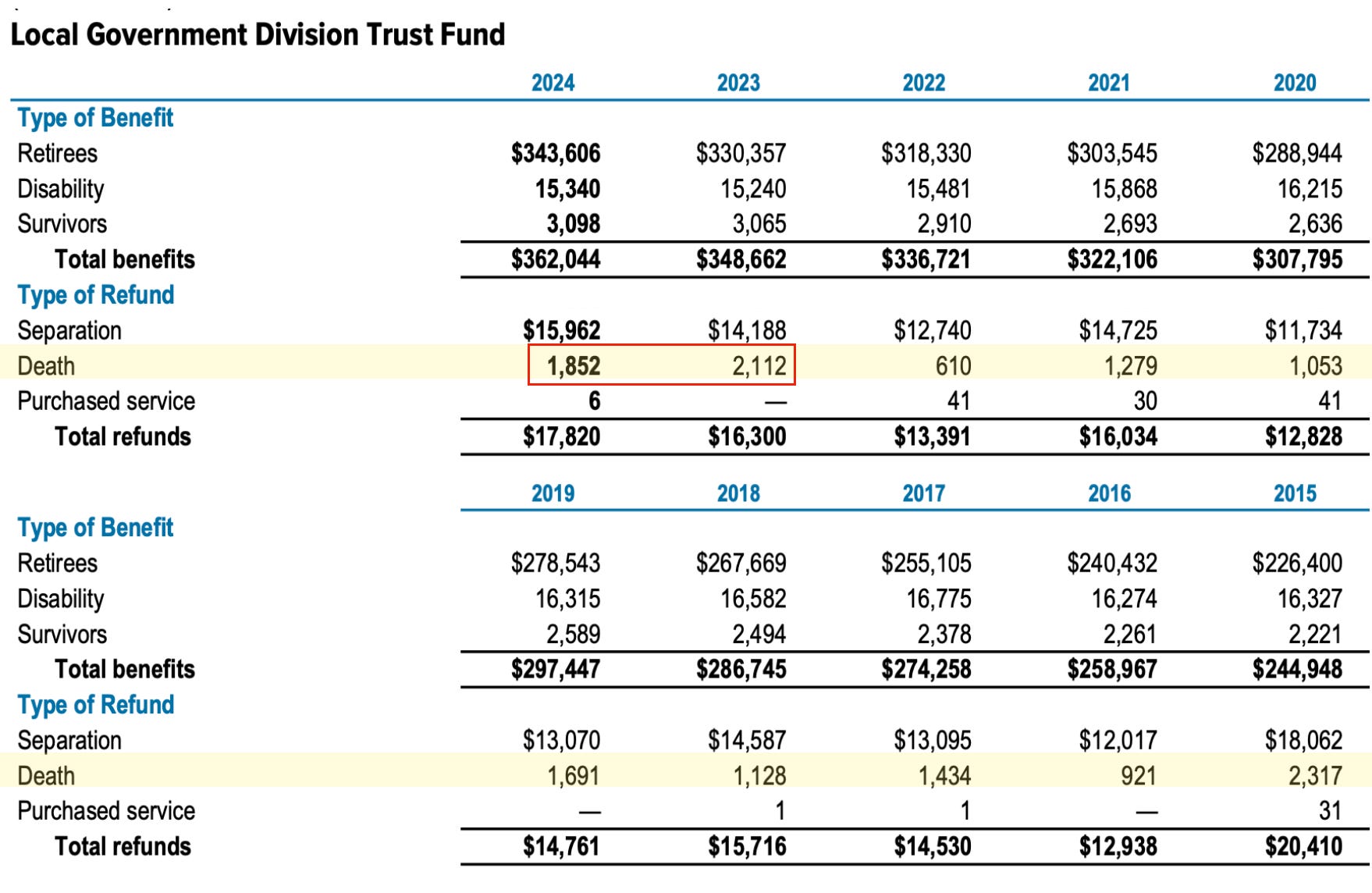
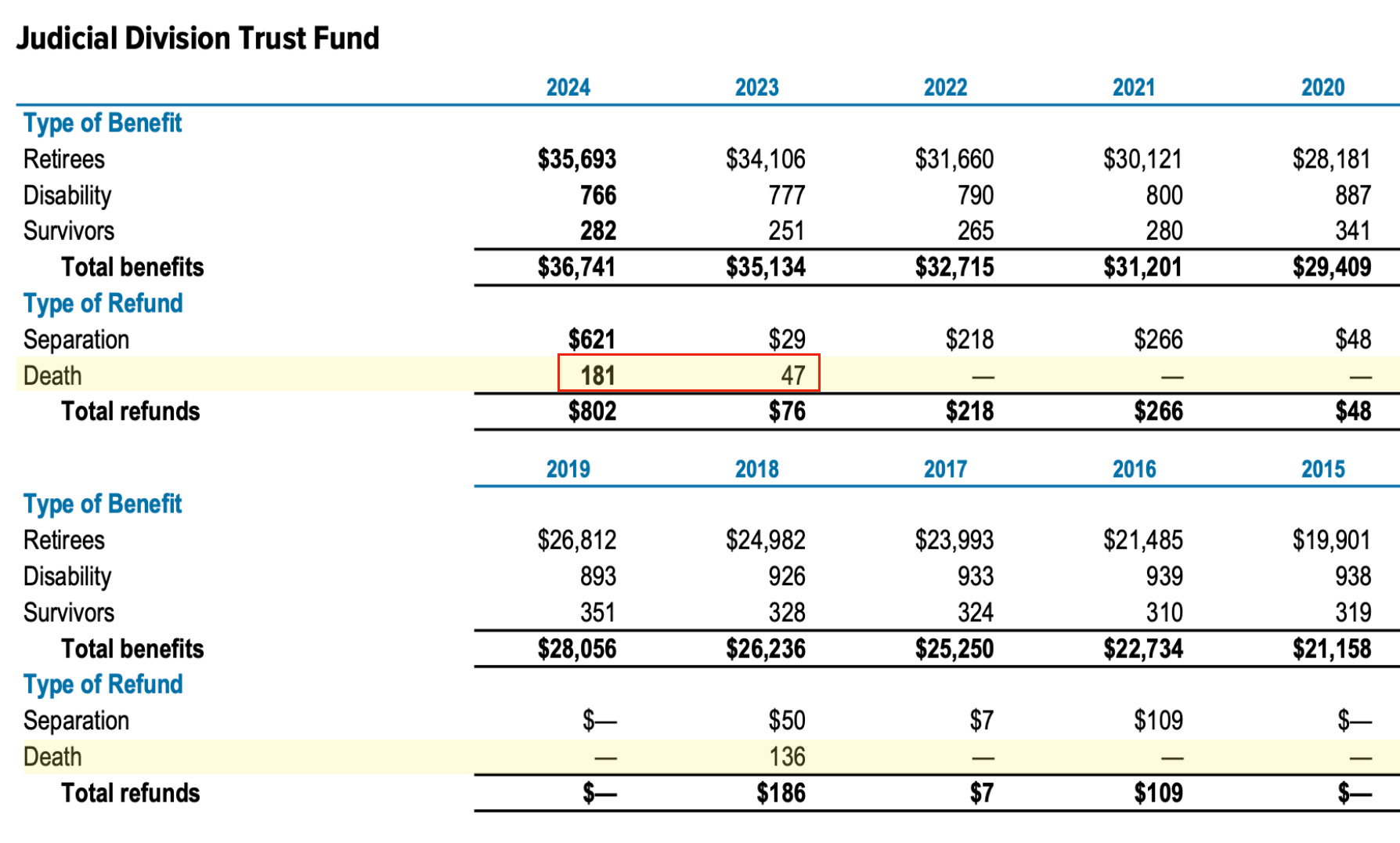
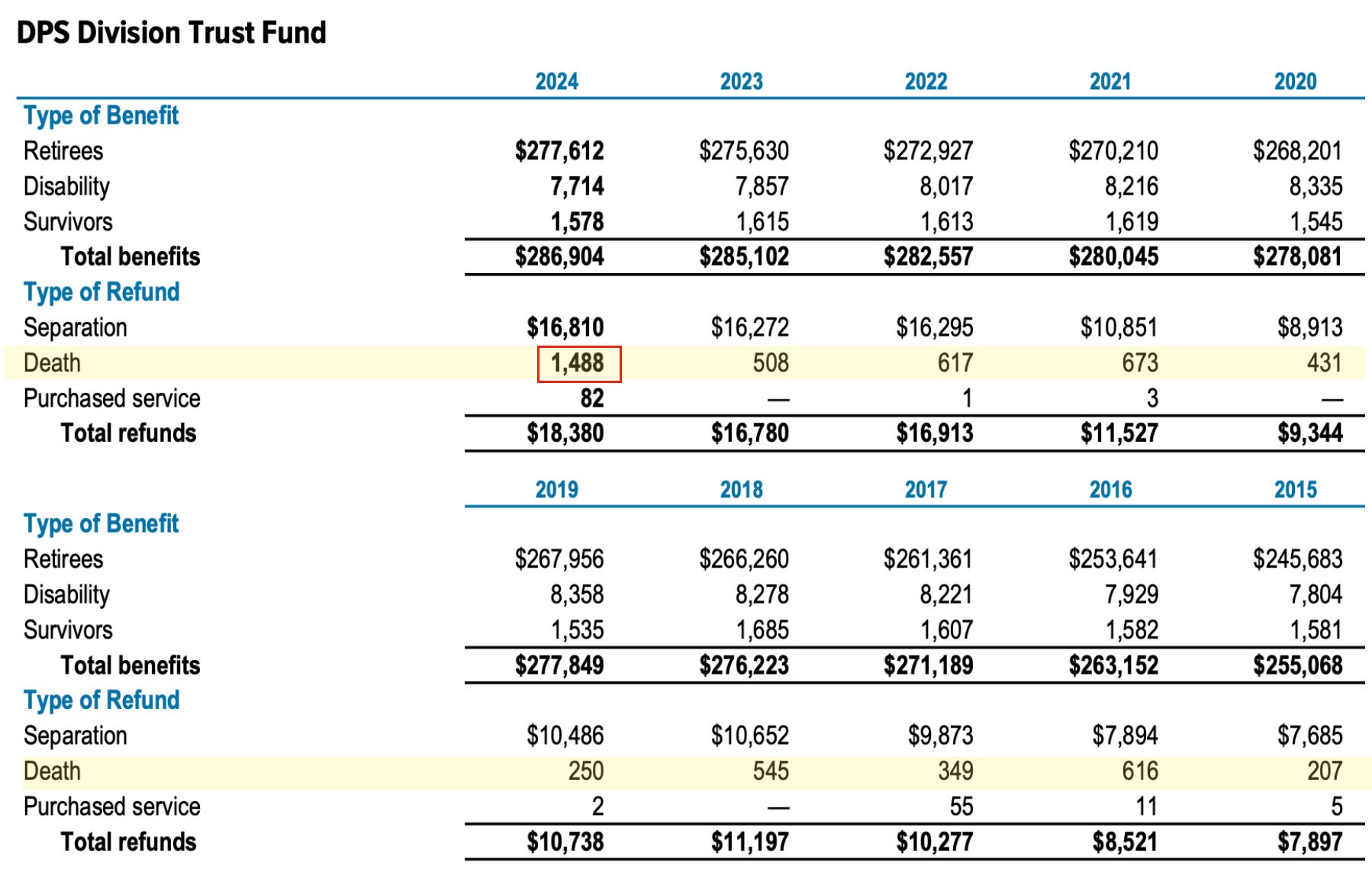
*these next tables are for the death refunds. Do remember that this is showing you the mortality for the still working members. If you are unclear about that, then look at this post.
In every group the death refunds are going up over time, with 2024 having the largest payouts. Not good.
.
pages 221 through 223 (BENEFITS AND REFUND DEDUCTIONS FROM FIDUCIARY NET POSITION BY TYPE)
.
.
.
.
.
.
.
Wow. I’m not even sure if that is everything in that damn long report!
.
.
.
Got to wrap this one up. My mind is mush. I think I am going to say that the Ghost Bomb Mob is a nine member group now … for the time being.
.
But let me just say one more thing before I go. I have been letting a couple of states in to the overall Ghost Bomb group even though the increased mortality was modest compared to the others. That would be Indiana and Virginia. Let’s entertain the notion that we leave those aside, along with D.C. because it is not in our pension rankings. That would leave a twelve state list of significant April/May mortality in 2020. Since I have just made my case to make this bad pension mob a total of nine members … that’s nine out of twelve now … do you think that there may be something going on here? And let me just remind you that two of the remaining three, Delaware and Louisiana, were the best performing pensions on their investments in 2021. Yes they were the gold and silver medalists for that.
Don’t you think this is a little curious?
.
.
.
*in case you have forgotten …
Pandemic Milestones:
January 20, 2020
-First covid case in the U.S.
December 11, 2020
-Pfizer Emergency Use Authorization
December 18, 2020
-Moderna Emergency Use Authorization
August 23, 2021
-Pfizer full FDA approval
December 2021 / January 2022
-CDC and FDA revise booster recommendations
-Rapid booster uptake
January 31, 2022
-Moderna full FDA approval
August 31, 2022
-FDA authorized Pfizer and Moderna’s new bivalent COVID booster vaccines
April 10, 2023
-Biden declares the end of the pandemic
.
.
.
The scheme seems to reveal its hand in this quote regarding the troubled pension fund (PERA):
“None of this even begins to address the financial calamity that will befall PERA with some medical advancement that extends life expectancy.”
In other words, increased life expectancy is a calamity for pension payouts. Conversely, this implies that reduced life expectancy increases pension solvency thanks to lowered payout expenses.
That pretty much sums up what we’re seeing, and we’re seeing it more every year since the vaccine rollout -- and in most states, not just Colorado.
An unrelated observation: “Bomb mob” is a palindrome, which suggests that as we go forward we’re going backwards ...
Glad to see another post in this line.
I'm coming to the conclusion that in 2020 the lockdowns and then iatrogenic hospital deaths caused a spike in deaths (April and May) but with some delay from the onset of the plandemic, as it sometimes took people some weeks to expire.
I only know of 2 people who died in hospital of covid, and both died right about then, both of organ failure after about 3 weeks on ventilators. I do not know the details, but looking back on it after having transcribed a very large batch of hospital horrors testimonies, I would wager that had these 2 been treated as pneumonia patients normally would have been treated, they'd have recovered and gone home. Instead hospital covid protocol left them isolated, probably severely neglected, and then the ventilators and paralyzing drugs (needed for patients on ventilators), together with remdesivir, did them in.
Everyone else I know who "died of covid," either it was really "with covid" when they were already dying of dementia or cancer, or, as in 2021-2022 especially, it was, curiously enough, directly after they partook of the "safe and effective."
Over and over again I am struck by how dark and weird all of convid times were, and so really unbelievable— and yet, it was so. Jeffrey Tucker makes this point in his recent Brownstone interview with Sonia Elijah. I can warmly recommend it.